
Mobile fuel bills are crushing margins: fix routing and pricing now
What to do about it
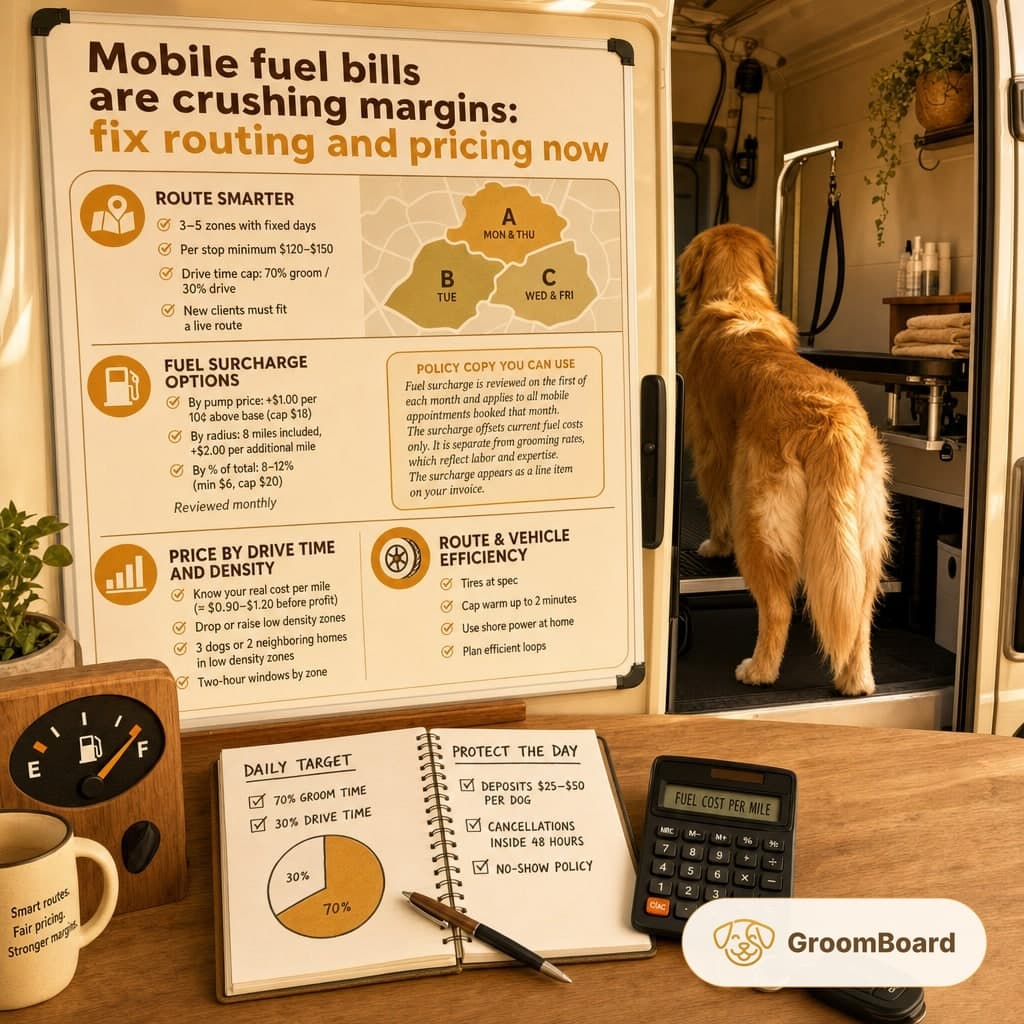
- Adopt zone days and require a per-stop minimum, for example 90 minutes of booked work or a dollar minimum like $120.
- Publish a fuel surcharge policy tied to pump prices or miles beyond a base radius, and review it monthly.
- Price by drive time and route density, not by ZIP alone, and prune low-yield zones each quarter.
- Track your true cost per mile and aim for 70 percent grooming time and 30 percent drive time in a mobile day.
- Improve MPG with tires at spec, reduced idling, lighter payload, and timely maintenance, then reevaluate the vehicle mix.
Fuel costs are forcing hard choices for mobile operators
The Cool Down reports that a California mobile dog groomer is paying about 4,000 dollars a month for fuel and has scaled back routes to survive. If your fill ups look like that, every unnecessary mile and empty gap is lost margin. Here is how to stop the bleeding without losing your core clients.
Stabilize margins with zone days and minimums
Route density beats everything. Split your service area into 3 to 5 zones and assign fixed days. Example: Zone A Monday and Thursday, Zone B Tuesday, Zone C Wednesday and Friday. Book only within that zone on its day unless the client pays a premium.
- Per stop minimum: Set a floor such as 120 to 150 dollars or 90 minutes of booked work. Multi pet homes count toward the minimum. If the home books below the minimum, add a make up fee to reach it.
- New client screening: Only accept new clients that fit a live route. Offer a waitlist or a higher out of zone rate for others.
- Drive time cap: Target a day where grooming time is about 70 percent of the clock and driving is about 30 percent. If you are flipping that ratio, raise prices in that zone or drop it.
Price increases land better when tied to schedule clarity. Publish a one page service area map with the day for each zone and the per stop minimum.
Set a transparent fuel surcharge policy
Clients accept fairness when they can see the math. Pick one approach and post it on your website, confirmations, and invoices.
- By pump price: Choose a base fuel price for your area, for example 4.00 dollars per gallon. Add 1.00 dollar per appointment for each 10 cents above the base, capped at 18 dollars. Adjust monthly.
- By radius: Include the first 8 miles one way. Charge 2.00 dollars per additional mile one way, measured from your start address to the client. Use the same tool every time to measure.
- By percentage: Add 8 to 12 percent fuel surcharge to the grooming total, with a minimum of 6 dollars and a cap of 20 dollars.
Policy copy you can use:
- Fuel surcharge is reviewed on the first of each month and applies to all mobile appointments booked that month.
- The surcharge offsets current fuel costs only. It is separate from grooming rates, which reflect labor and expertise.
- The surcharge appears as a line item on your invoice.
Pair the surcharge with deposits and a clear no-show policy to protect the day. A 25 to 50 dollar deposit per dog or 25 percent of the estimate is standard for mobile. For cancellations inside 48 hours, retain the deposit unless the slot is rebooked.
Price by drive time and density, then prune
Know your real cost per mile and charge accordingly. A simple model works: fuel cost per mile equals pump price divided by your true miles per gallon. Add 20 to 40 cents per mile for wear, maintenance, and replacement, then add your hourly rate converted to a per mile number based on average speed. Many mobile rigs land between 90 cents and 1.20 dollars per mile of real cost before profit. Use your own numbers, then build margin in.
- Quarterly zone review: Drop zones with fewer than 3 stops per hour of drive time, or raise those zone rates by 15 to 25 percent and keep them only if they stick.
- Minimum density rules: In low density zones require either a 3 dog household or 2 neighboring homes on the same street. Offer 10 dollars off each if both book the same window to help you hit the minimum.
- Time windows, not exact times: Offer a two hour window by zone. Exact times create dead space and force wasteful loops.
Protect turnaround time by sizing appointments realistically. Small and medium dogs usually need 60 to 90 minutes. Large coated or heavy de shed can be 2 hours or more. Build these into the route with no backtracking.
Route and vehicle efficiency you can act on this week
- Tires at spec: Set tire pressures to the door label when the tires are cold. Under inflation can cut several miles per gallon.
- Reduce idling: Cap warm up to two minutes. Use shore power at home to pre chill or pre charge equipment when possible.
- Lighten the load: Remove duplicate tools and nonessential inventory. Every 100 pounds hurts MPG.
- Maintenance: Fresh air filter, correct oil weight, alignment, and timely spark plugs matter for vans that stop and start all day.
- Driving habits: Smooth throttle, earlier braking, and planning right turns where legal saves time and fuel.
- Routing help: Use your booking tool to cluster stops and sort by shortest path. GroomBoard maps the day’s stops and suggests an efficient order from your start address so you avoid wasteful zig zags.
Track it. Log miles, gallons, and dollars daily. Post a simple KPI on your calendar each week such as dollars of revenue per mile and minutes of drive time per stop. Trends will tell you if the new rules are working.
Medium term, reconsider the rig mix
If fuel keeps climbing, the vehicle may be the constraint. Run a six month total cost comparison for your routes.
- Right size the platform: A lighter van or trailer pulled by a hybrid SUV can fit many single groomer setups with a portable table and high velocity dryer. Fewer gallons burned means instant margin.
- Plug in option: A plug in hybrid that covers your typical daily miles on battery and uses gas only beyond that can halve fuel spend on dense routes. Check payload and power needs for clippers, dryer, and water heater before committing.
- Full electric: Emerging electric vans can work on short urban routes with reliable charging. Upfront cost can be high. Run the math on electricity per kWh versus gas, range with payload, and winter performance.
- Two vehicle strategy: Keep the big rig for multi pet or full spa days, and add a smaller high MPG vehicle for bath and tidy or short coat clients. Book them on different days by zone.
The headline is a warning. Fuel can erase your month even with full books. Set the rules that protect your time and miles, explain them clearly, and enforce them. Clients who value in driveway service will adjust if they trust the process.