
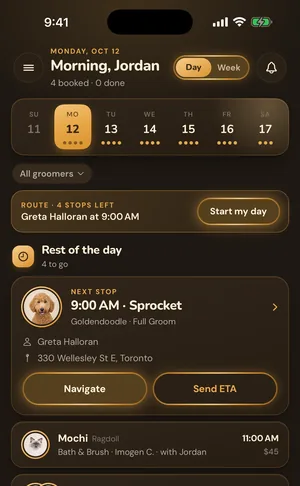
GroomBoard on your phone.
Your day, your route and checkout in your pocket. Sign in with the account you already have.
- iPhoneApp StoreIn review
- AndroidGoogle PlayComing next
GroomBoard on your phone.
Your day, your route and checkout in your pocket. Sign in with the account you already have.
- iPhoneApp StoreIn review
- AndroidGoogle PlayComing next
Free Tool
Grooming Commission Calculator
See exactly how a commission split divides each groom between the groomer and the salon, and what it adds up to weekly, monthly, and per year.
Average Price per Groom
/groom
Commission Rate
to groomer
Most salons pay groomers 40 to 60% commission
Grooms per Week
/week
Weeks Worked per Year
weeks
Accounts for vacation and time off (52 = full year)
The Split, Per $70 Groom
Groomer Takes
$35.00
50% commission
Salon Keeps
$35.00
50% to cover rent, supplies, overhead
Groomer Earnings
Per Week
$875
Per Month
$3,646
Per Year
$43,750
Gross commission before taxes and any tools/supplies the groomer provides. The salon grosses $43,750/year from this groomer to cover overhead and profit.
Email me this breakdown
Get these numbers plus our guide to structuring groomer pay fairly and legally.
Stop working this out again every payday
You just did one groom. Payday is a few hundred of them. On GroomBoard each groom is already booked against the groomer who did it, so the split adds itself up and you read the total instead of rebuilding it in a spreadsheet.
How grooming commission works
Commission is the most common way salons pay groomers: the groomer earns a percentage of every groom they complete, and the salon keeps the rest to cover rent, utilities, supplies, software, and profit. Most salons pay groomers 40 to 60% commission, with experienced groomers and those who bring their own clients at the higher end.
Commission vs. hourly
Straight commission rewards productive groomers but leaves slow days unpaid. Hourly gives stability but less incentive. Many salons use a hybrid, a base hourly wage plus a smaller commission, to balance both. Whatever the structure, employees must still earn at least minimum wage and overtime under the Fair Labor Standards Act.
A word of caution on classification
Paying a groomer on commission does not make them an independent contractor. If you set their schedule and prices and provide the tools, the IRS considers them an employee, and misclassifying them is expensive. We break this down in our guide to hiring dog groomers.