
Fuel spike playbook for mobile groomers: surcharge and routing
What to do about it
- Calculate your fuel cost per dog, then set a surcharge or travel fee that fully covers it.
- Publish clear travel zones, route by neighborhood days, and enforce a per stop minimum.
- Use a price update trigger tied to average pump price changes to adjust quickly.
- Collect a 25 to 50 percent deposit and authorize cards for variable surcharges.
- Track revenue per mile and miles per dog weekly to confirm the changes are working.
Fuel prices are biting mobile margins again
According to a report from YourCentralValley.com, Fresno pet groomers are making tough decisions as fuel prices rise. If you are mobile or offer pickup and delivery, every extra mile now comes straight out of margin. The operators who move first, with clear math and clear client communication, will keep their schedules full and cash flow steady.
Know your real fuel cost per dog
Price from math, not vibes. Use numbers you can explain in one sentence.
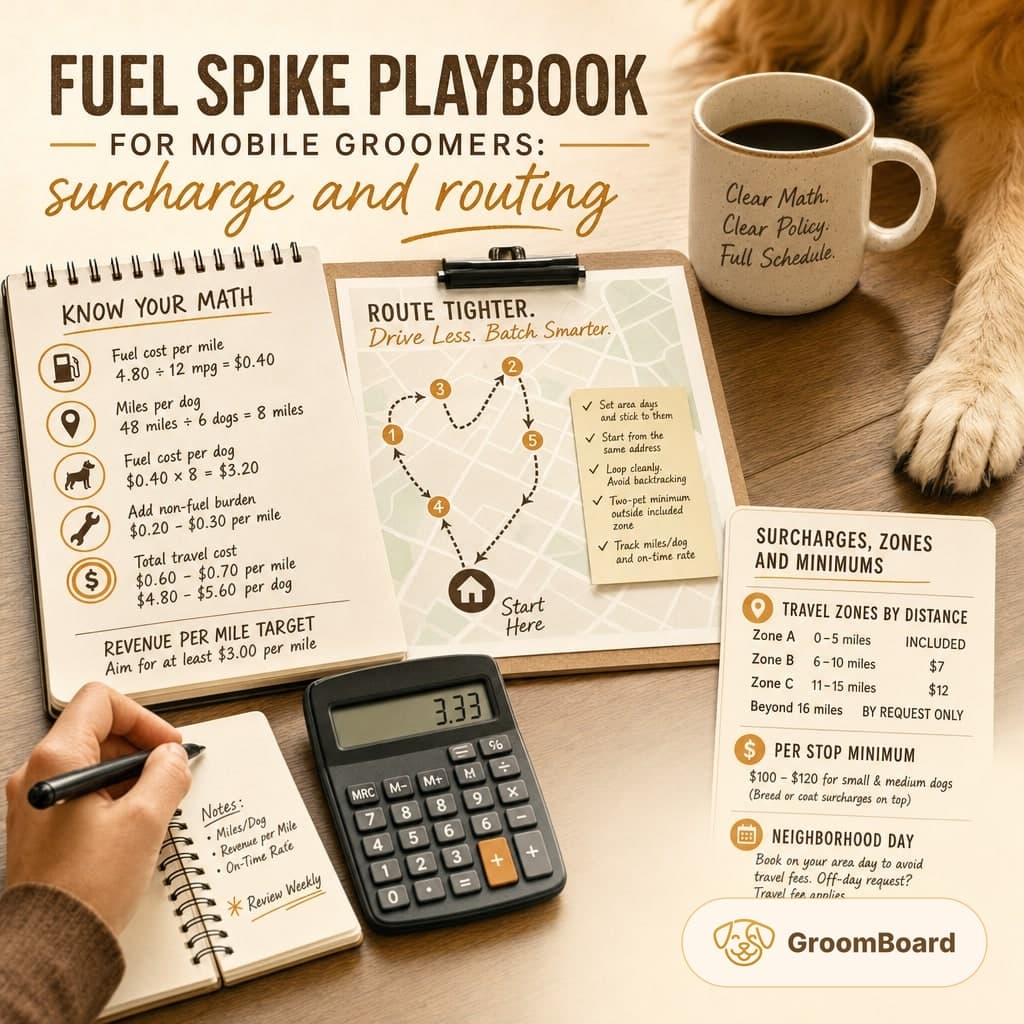
- Fuel cost per mile: pump price divided by your actual miles per gallon. Example: if you get 12 mpg and gas is 4.80 per gallon, fuel is 0.40 per mile.
- Miles per dog: total route miles for the day divided by dogs completed. Example: 48 miles and 6 dogs equals 8 miles per dog.
- Fuel cost per dog: cost per mile times miles per dog. With the examples above, 0.40 times 8 equals 3.20 fuel per dog.
Add your non fuel travel burden. A simple target is 0.20 to 0.30 per mile for tires, oil, depreciation, and time lost to traffic. With that, travel cost in the example lands near 0.60 to 0.70 per mile, or 4.80 to 5.60 per dog.
Set a revenue per mile target and watch it weekly. Many mobile operators aim for at least 3.00 revenue per mile across the day. If you finish a day at 150 miles and 500 in revenue, that is 3.33 per mile. If your route mix cannot clear 2.50 per mile, your pricing or zoning needs work.
Surcharges, zones, and minimums that hold margin
Pick a structure you can post and defend. Use one of these, or a mix.
- Temporary fuel surcharge per stop: set it to cover your fuel cost per dog plus a buffer. In the examples above, a 5 to 8 dollar per appointment surcharge is reasonable. Review weekly and remove when prices settle.
- Travel zones by distance: include travel within your core radius, then add fees outside it. Example: Zone A 0 to 5 miles included, Zone B 6 to 10 miles 7 dollars, Zone C 11 to 15 miles 12 dollars, beyond 16 miles by request only.
- Per stop minimum: set a mobile minimum ticket that reflects your drive time. Common ranges we see are 100 to 120 dollars for small and medium dogs, with breed or coat surcharges stacked on top.
- Neighborhood day discount or requirement: clients can avoid travel fees if they book on your set day for their area. If they want an off day slot, the travel fee applies.
Publish this on your website, booking form, and confirmations. The goal is no surprises at the door.
Route tighter, drive less, batch smarter
Every extra turn costs fuel and minutes. Systematize routing.
- Set area days and stick to them. For example, North side Tuesday and Thursday, South side Wednesday and Friday. Block the calendar so one stray request cannot break clustering.
- Start from the same address each day and order stops to loop cleanly. Avoid backtracking. If you use GroomBoard, the mobile calendar maps the day and suggests a shorter driving order based on your start address.
- Enforce a two pet minimum for addresses that fall outside your included zone. Neighbors can coordinate, you do not eat the dead miles.
- Batch big jobs. Do not pair two 3 hour dogs on opposite sides of town on the same day when fuel is spiking.
Track two metrics after the change: miles per dog and on time arrival rate. If miles per dog drops and on time holds steady, the routing rules are working.
Update prices fast and tell clients clearly
When fuel is volatile, use a trigger to avoid endless back and forth.
- Set a public trigger: if the average local pump price changes by 0.25 per gallon or more from last month, your surcharge updates the following Monday. Round to the nearest whole dollar.
- Add the surcharge as a separate line on estimates, confirmations, and receipts. Clients can see it appear and disappear with fuel price changes.
- Policy wording you can copy: We use a temporary fuel surcharge when local pump prices are elevated. It is reviewed weekly and removed when prices normalize. Travel within 5 miles is included. Outside that radius, a posted travel fee applies.
Train your script. Keep it short, confident, and free of apology. The work is the same quality, the van costs more to run. Most clients understand when the structure is fair and visible.
Protect cash flow while prices are high
Trips are more expensive to miss, so tighten your money rules.
- Deposit: collect 25 to 50 percent at booking for mobile or pickup and delivery. Apply it to the final invoice. Same day cancellations forfeit the deposit.
- Card on file: capture a card and pre authorize the expected invoice total including the current surcharge and travel fee. Adjust at checkout.
- Minimum charge on arrival: if access issues or behavior stop the groom, charge the travel fee and 50 percent of the service minimum to cover the trip.
- Reschedule window: allow free reschedule with 48 hours notice. Inside 48 hours, the deposit moves to the new slot once per client per quarter, then the policy applies.
Review the numbers after two weeks. If your revenue per mile is still under target, increase the surcharge by 1 or 2 dollars, expand the included zone only if your density supports it, or raise the per stop minimum.
Finally, make it easy to implement. Your booking tool should let you add a surcharge line, require deposits, and reflect zone fees in confirmations. If you are evaluating software, confirm it supports online payments, SMS confirmations, and basic route visibility so these changes do not become more admin work.