
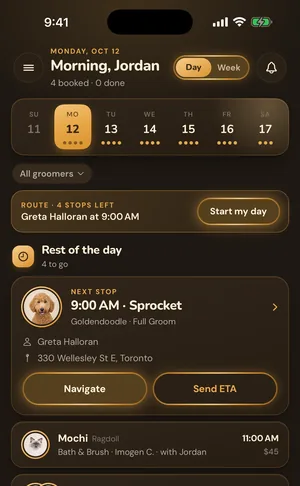
GroomBoard on your phone.
Your day, your route and checkout in your pocket. Sign in with the account you already have.
- iPhoneApp StoreIn review
- AndroidGoogle PlayComing next
GroomBoard on your phone.
Your day, your route and checkout in your pocket. Sign in with the account you already have.
- iPhoneApp StoreIn review
- AndroidGoogle PlayComing next
Dog Grooming Services
Complete guide to 15 grooming services. Pricing, duration, process, and breed specific guidance, built for working groomers.
Why service taxonomy matters more than anyone admits
Most grooming businesses price and schedule every dog using a vague “full groom” service plus a size add on. The math works on paper. It falls apart the moment a matted doodle, a nervous senior, or a pristine poodle show dog walks through the door. One takes 30 minutes longer than the quoted slot. The next one needs a different approach entirely. The third one is booked at the same price as a brand new client who has never sat on a grooming table before. Every hour of your week is a time estimate, and every time estimate is a bet. The businesses that make money are the ones that bet well.
Building out your service taxonomy, distinct services with distinct durations and distinct prices, is how you stop guessing. It is the single highest leverage change a groomer can make to their business. You stop double booking. You stop discovering at pickup that the dog needed an extra 45 minutes you could not charge for. You stop feeling like clients are getting away with paying less than the work required. Everything downstream, scheduling accuracy, margin per hour, client retention, staff trust in the system, flows from a service menu that reflects reality.
This pillar page exists because most groomers learn service design piecemeal. One week you add a deshed because spring shedding season hit and clients are complaining. Another month you start charging extra for matted dogs because you lost three hours on a cockapoo rescue. Two years in, your service menu is a patchwork of decisions made in reaction to bad weeks. The guides that follow, 15 of them, are the opposite of that. They are the service menu you would design if you could start from scratch today, with a working groomer’s understanding of what each job actually takes.
The three service categories working groomers use
Every service in a grooming business fits into one of three categories: bathing, trimming, or specialty. This is not an arbitrary taxonomy. It maps to the actual workflows, tools, and pricing logic of the trade. Bathing services share a tub, a dryer, and a set of shampoos. Trimming services share shears, clippers, and a grooming table. Specialty services share expertise, specific training, specific experience, and specific client expectations that justify specific pricing. Organizing your service menu this way makes it easier to cross train staff, easier to explain pricing to clients, and easier to schedule around equipment capacity. Every service spoke linked below is grouped into one of these three buckets.
Bathing services are the entry point to a grooming business. Every dog that comes through needs a bath. The subservices, basic bath, deshedding, flea treatment, ear cleaning, anal gland expression, all happen in or around the tub. The economics of bathing services live in two places: the base bath price (which must reflect coat type, because a double coated Samoyed takes three times the drying time of a Beagle), and the add ons that stack onto every bath. A salon that nails its bath pricing captures revenue on every single client because the bath is nonnegotiable. A salon that underprices bathing services gives away margin on their highest volume service: the worst kind of leak.
Trimming services are where craftsmanship lives. Haircuts, nail trims, and teeth brushing require precision, steady hands, and, in the case of haircuts, a creative eye and a consistent hand across visits. The economic logic of trimming services is different from bathing. Trimming is time intensive, coat intensive, and style intensive. A haircut priced at $55 takes 90 minutes of focused work; your hourly rate on that service is tight. Clients evaluate trimming services visually. They can see whether the cut matches what they asked for, whether the lines are clean, whether the face looks right. This is where recurring clients are made or lost. Getting trimming services right is about documentation (saving clipper guards, photos, and client preferences per pet) and consistency (a client returning in six weeks should see the same cut the same way).
Specialty services are where a grooming business grows beyond the salon average. Puppy first grooms, senior dog grooming, show grooming, hand stripping, cat grooming, doodle grooming, mobile grooming, these are services most groomers cannot perform, or will not invest in. That scarcity is where pricing power lives. A groomer who can hand strip a wire coated terrier breed correctly can charge $120 to $180 for what is a 2 to 3 hour job, and clients travel for the service because so few groomers offer it. The same logic applies to cat grooming, show grooming, and mobile grooming. Specialty services also protect your client base against competition: a general purpose groomer down the street does not threaten a salon that is the only one in the county doing proper poodle show trims. Building at least one specialty service into your menu is how a grooming business becomes a destination.
How to price a service menu that actually holds up
The oldest pricing model in grooming is the size based full groom price. Small: $50. Medium: $65. Large: $85. XL: $110. It is simple, it is easy to communicate, and it is wrong. Size is a proxy for time, but it is a weak one. Coat condition, coat type, and temperament are stronger predictors of how long a dog takes than size alone. A clean 80 pound Lab is faster to bathe than a matted 15 pound cockapoo. A calm 60 pound Golden is faster to finish than an anxious 25 pound terrier. Pricing by size and ignoring these factors means you are subsidizing the hard dogs with the easy ones: the clients you least want to lose are the ones who effectively pay more than they should, and the clients who are draining your schedule pay less.
A pricing model that holds up in the real world has three dimensions: a base price per service, a size adjustment, and a coat condition surcharge. The base price per service reflects the time that service takes on a standard dog in clean condition. The size adjustment (usually 10 to 25% up or down from medium) reflects extra labor for larger dogs. The coat condition surcharge, typically 20 to 40% on top of the base, kicks in when a dog arrives matted or needs significant extra work. When you price by all three dimensions, every dog pays in proportion to the work you actually do. No more subsidies. No more resentment about the tough client who always shows up on your busiest day.
On top of that base, add on services are where the margin quietly accumulates. A nail trim, teeth brushing, ear cleaning, and anal gland expression added onto a bath lifts the average ticket from $50 to $85, a 70% increase, for maybe 15 minutes of additional work. Most clients will happily approve these add ons when they are checkboxes on the booking page. Very few will approve them when you surprise them at pickup. This is why add on capture at booking is one of the most profitable decisions a grooming business can make. Every service in the 15 guides below notes which add ons naturally pair with it, so you can build your booking page for maximum capture.
How GroomBoard handles each of these services
GroomBoard is built around the idea that every grooming business is a collection of distinct services, each with its own duration, price, and rebook cadence. In the dashboard, you configure each service independently: the base price, the duration, the staff who can perform it, the coat types it applies to, the add ons it supports, and the SMS reminder cadence for rebooking. A bath might be configured at 45 minutes, $40 base, with five optional add ons. A full haircut might be 90 minutes, $70 base, with three add ons and a recurring rebook set to six weeks. A hand strip might be 180 minutes, $140 base, with no add ons and a recurring rebook set to ten weeks. Every service in your menu has its own math, and that math drives your schedule.
On the booking page, clients see the full menu, the clear price ranges, the estimated duration, and the available add ons. They self select the service that fits their dog, tick the add ons they want, and drop into a time slot that actually accommodates the work. No more phone calls with clients who booked a “full groom” for a matted doodle in a 60 minute slot. No more renegotiating prices at pickup. The service menu you build inside GroomBoard is the service menu your clients see and book into.
Behind the scenes, GroomBoard tracks every service as a row in your business. You can see at the end of the month that you delivered 42 baths at an average of $44, 38 haircuts at an average of $72, and 6 hand strips at an average of $155. You can see which add ons were accepted and which were ignored. You can see which services drive the highest rebook rate and which ones bring clients back on rhythm. This data is what separates a grooming business that grows from one that plateaus. Every decision, raising a price, launching a new service, retiring a low margin offering, cross training a staff member on a specialty, gets better when you can see the numbers behind the work.
How to use the service guides that follow
Each of the 15 guides linked below goes deep on a single service. You get the pricing logic, the step by step process, the common pitfalls, the breed fits, and the FAQ clients actually ask. They are written for working groomers, no SEO fluff, no lifestyle content, just the working knowledge you need to run each service profitably. Bookmark the ones you already offer; read the specialty guides even if you do not offer those services yet, because the margin math might change your mind.
For groomers who are just starting a business: use these guides to build your initial service menu from first principles. Pick a core of 6 to 8 services to launch with, price them using the three dimensional model, and add one specialty service within the first year to differentiate your salon. For established groomers: use these guides to audit the services you already offer. Compare your pricing and durations against the ranges in the guide and see where you have been leaving margin on the table. Every business that uses GroomBoard is running some combination of these services, and every one of them is a decision you are making, whether you intended to or not.
Browse all 15 services
Bathing services(5)
Baths, deshedding, flea treatment, ear cleaning, and anal gland expression. The bread and butter of any grooming business.
Dog Bath
Professional bathing with coat appropriate shampoo, thorough drying, and finish work.
Flea Treatment Bath
Medicated flea bath with a pet safe insecticide shampoo and thorough combing.
Deshedding Treatment
Deep undercoat removal with HV drying, deshedding shampoo, and specialized rakes.
Ear Cleaning
Gentle ear canal cleaning with pet safe solution and cotton, plus ear hair plucking when needed.
Anal Gland Expression
Manual external expression of the anal glands during bath time.
Trimming services(3)
Haircuts, nail trims, and teeth brushing. Precision work that clients rebook on rhythm.
Dog Haircut
Precision coat trim using clipper guards, scissor work, and client preferred length.
Dog Nail Trim
Precise nail clipping or grinding on all four paws, including dewclaws.
Dog Teeth Brushing
Professional tooth brushing with pet safe paste, often bundled with a bath.
Specialty services(7)
Puppy first grooms, senior dog grooming, show grooming, hand stripping, cat grooming, doodle grooming, and mobile grooming. Expertise commands premium pricing.
Puppy's First Groom
Gentle introduction to bathing, clipper sounds, and handling for puppies under 6 months.
Senior Dog Grooming
Low stress, shorter session grooming for senior dogs with joint, skin, or sensory issues.
Show Grooming
Conformation ready styling to breed standard for show dogs and exhibitions.
Hand Stripping
Traditional plucking technique that maintains wire coat texture for terriers and spaniels.
Cat Grooming
Stress minimized bathing, brushing, nail trims, and lion cut styling for cats.
Doodle Grooming
Dedicated trimming and dematting for goldendoodles, labradoodles, and doodle crosses.
Mobile Grooming
Full service grooming performed in a self contained van at the client's home.
Frequently asked questions
How many services should a grooming business offer?
Most working grooming businesses offer between 8 and 15 services. A solid core is: basic bath, deshed, full haircut, nail trim, teeth brushing, ear cleaning, and one or two specialty offerings. Too few services limits revenue; too many creates scheduling confusion. GroomBoard lets you set each service with its own duration and price tier so clients pick exactly what they need.
How do I price each service?
Start with time cost. Calculate your target hourly rate (most groomers aim for $60 to $80/hour after expenses), multiply by the service duration, and add product cost. Then layer in a tiered surcharge for coat condition (clean, moderate, matted) and size. A 90 minute haircut on a matted large dog should not cost the same as a 60 minute haircut on a clean small dog. Build that reality into your pricing, not your head.
Which services have the best margin?
Add on services (nail trims, teeth brushing, ear cleaning, anal gland expression) have the highest margin because they take 5 to 15 minutes and piggyback on a bath or full groom with no extra setup. Specialty services like hand stripping and show grooming command premium pricing but require training and time. Deshedding has unique economic leverage because it lifts the average ticket by $20 to $40 on a service clients are already booking.
How often do clients rebook each service?
Baths: every 3 to 6 weeks depending on coat type. Haircuts: every 4 to 6 weeks for curly and long coats. Nail trims: every 3 to 4 weeks. Deshedding: every 6 to 8 weeks, with peaks in spring and fall. Specialty services vary widely. GroomBoard sets a recurring SMS reminder per service, so clients get nudged at exactly the right interval without you having to chase them.
Can GroomBoard handle service add ons at booking?
Yes. Every service on the booking page can display optional add ons (nail grind, sanitary trim, teeth brushing, deshed upgrade) as checkboxes that clients self select during checkout. This captures upsell revenue that would otherwise be negotiated at pickup, and it keeps the schedule accurate because the base service plus add ons have a combined duration.
Build your service menu on GroomBoard
Configure every service with its own duration, price, and rebook cadence. 7 day free trial.
Start free trial