Hold the line on health costs without dropping coverage
What to do about it
- Decide your employer health budget per employee first, then shop plans to fit that number.
- Ask your broker to quote fully insured, level funded, and defined contribution options side by side.
- Use a high deductible HSA plan with an employer HSA seed and clear cost sharing to lower premiums.
- Consider a PEO when you want bundled HR and potentially broader plan access, but model all in costs.
- Cover increases with a small per ticket price change and publish the new rates before open enrollment.
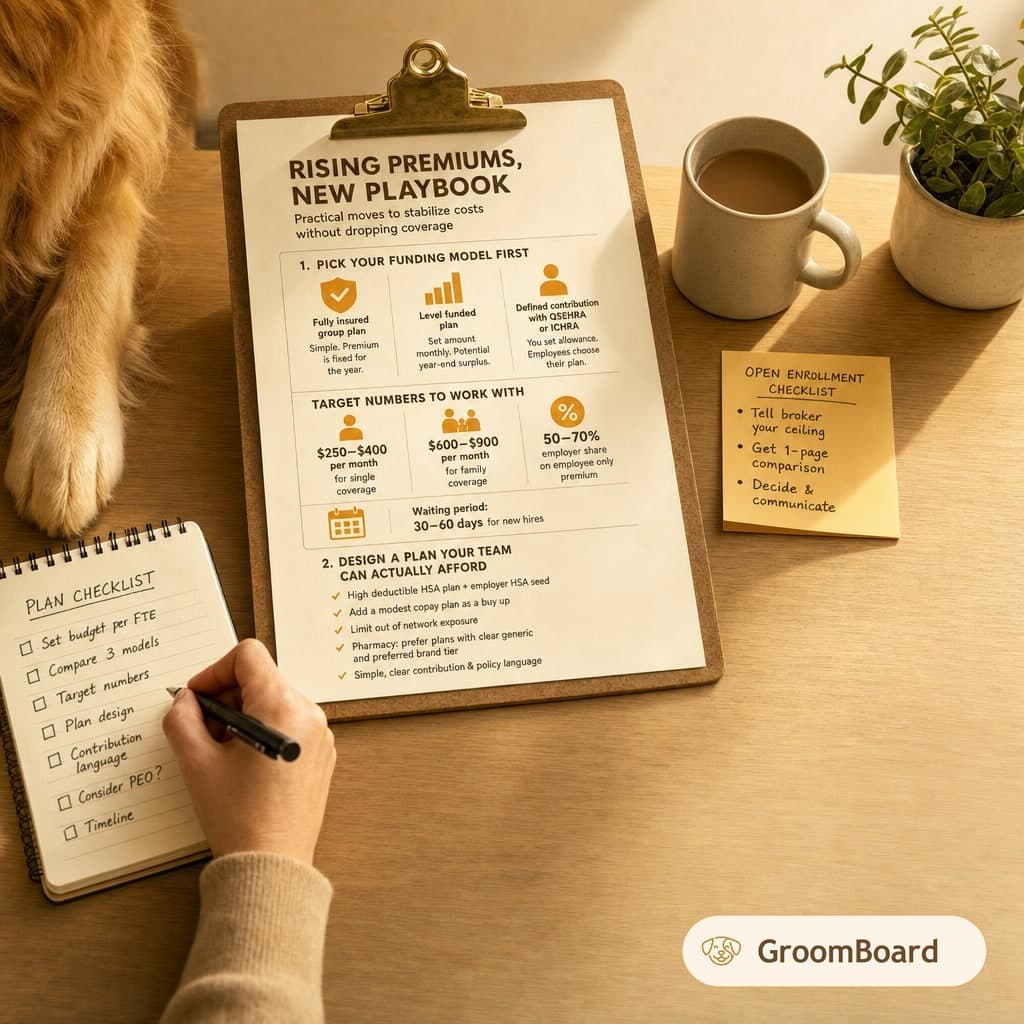
Rising premiums, new playbook
The Business Journals reports that health insurance costs are spiking for small employers, prompting new strategies. If you run a shop with a few bathers and stylists, renewal choices in the next few weeks will set your labor spend and your price list for the next year.
Here is a practical menu to stabilize costs without dropping coverage, plus exact steps to execute before open enrollment hits.
Pick your funding model first
Decide what you are solving for. Set an employer health budget per full time employee, then match the model to your number.
- Fully insured group plan: Simple to administer. Premium is fixed for the year. Works when you want predictability and do not want to manage claims risk.
- Level funded plan: You pay a set monthly amount that includes claims funding, stop loss, and admin. If claims run light, there may be a surplus at year end. Ask your broker to model a conservative scenario where there is no surplus, and a best case with a partial refund, so you can see both ends.
- Defined contribution with QSEHRA or ICHRA: You set a monthly allowance, employees buy their own individual coverage and get reimbursed tax efficiently if they choose qualifying plans. This caps the employer cost and shifts plan choice to the employee.
Target numbers to work with:
- Employer budget for defined contribution: 250 to 400 per month for single coverage, 600 to 900 for family, scaled to your market and margins.
- Employer share on a group plan: 50 to 70 percent of the employee only premium. Many small shops cap or do not subsidize dependents.
- Waiting period: 30 to 60 days for new hires to reduce churn costs.
Tell your broker your hard ceiling per employee, and ask for a one page comparison of fully insured, level funded, and QSEHRA or ICHRA that shows total employer spend under each.
Design the plan your team can actually afford
Premiums drop when you raise deductibles and steer to narrower networks, but you need to blunt the pain on day one costs. A practical setup for grooming shops:
- Choose a high deductible HSA plan as the base. Pair it with an employer HSA seed such as 300 to 600 annually for singles and 600 to 1,200 for families. Fund it quarterly to manage cash flow.
- Add a modest copay plan as a buy up. Employees who want first dollar copays can pay the difference through payroll.
- Limit out of network exposure. A narrow network with strong local hospitals is usually fine for a shop team that stays local.
- Pharmacy: prefer plans with a clear generic and preferred brand tier. Educate employees to ask for generics first.
Contribution and policy language you can use:
- The shop pays 60 percent of the employee only premium on the base plan. Dependents may enroll at full cost through payroll deductions.
- HSA funding is 25 per paycheck for singles and 50 per paycheck for families while enrolled in the base plan.
- Dental and vision are offered as voluntary. Employees pay the full premium through payroll.
If you move to QSEHRA or ICHRA, keep the allowance simple. One rate for full time and a lower rate for part time if allowed. Provide a short list of brokers or navigators who can help employees shop individual plans.
When to consider a PEO
A Professional Employer Organization can bundle payroll, HR compliance, workers comp, and access to a broader set of health plans. It can be a fit when you want one vendor for people operations or when your small group quotes are poor.
How to evaluate a PEO:
- Ask for an all in price that includes admin fees, workers comp, payroll taxes, and the health plan you would pick. PEO fees are commonly structured as a percentage of payroll or a per employee monthly fee. Get both expressed as a monthly dollar amount for apples to apples comparison.
- Confirm how state taxes, overtime rules, and terminations are handled. You will still manage performance and scheduling, the PEO handles filings and infrastructure.
- Model the exit. Ask what it costs and how long it takes to spin back out to your own group plan if needed.
Budget, pricing, and timeline
Do the math before you sign anything, then move quickly. A simple framework:
- Quantify the increase. Take your current annual employer health spend, compare to each quote under your chosen contribution strategy. The delta is what you must fund.
- Translate the delta to price per dog. Example: if the increase is 4,000 a year and you complete 1,800 grooms a year, add about 2.25 per ticket to cover it.
- Update your price list and publish the change two weeks before it takes effect. If you use software with weight based tiers, adjust each tier consistently and update online booking to prevent surprises. If you use GroomBoard, revise your visual calendar services and enable online deposits to smooth cash flow while the change settles.
- Communicate to staff. Share the employer budget, the plan options, and exactly how payroll deductions will look on a sample paycheck.
- Lock the renewal. Aim to finish decisions at least 30 days before the plan start to allow enrollments and HSA setup.
If you are pivoting to QSEHRA or ICHRA from a group plan, build in extra time to issue notices, cancel the old policy cleanly, and help employees shop. A 45 to 60 day runway is practical for a team of five to ten.
What to ask your broker today
- Show me three plan designs at my budget: Bronze level HSA, Silver level HSA, and a copay plan. Include employer cost if I pay 60 percent of employee only.
- Quote a level funded alternative at the same plans. Show both a no surplus and a modest surplus scenario.
- Provide a QSEHRA or ICHRA proposal with employer allowances set at 300 for singles and 750 for families. Include any required admin fees.
- If you work with a PEO partner, provide a side by side that shows total employer monthly cost for my team count, including all admin and taxes.
Rising premiums do not have to force you to drop coverage. Pick the funding model that fits your margins, design a plan your team can use, and bake the increase into your price list with clear lead time.