Control 2027 health costs without losing your best groomers
What to do about it
- Set a fixed 2027 employer contribution per full time employee and stick to it.
- Ask a broker to quote fully insured, level funded, and HRA options against your budget cap.
- Price each groom to fund the benefit, about 2 dollars per groom per covered employee for a 300 dollar monthly contribution.
- Use a simple written policy on eligibility, waiting period, and contribution so there are no surprises.
- Communicate changes 60 days before renewal, and offer a taxable stipend only if no compliant plan fits.
Premiums are up, so set your 2027 plan now
Employee Benefit News reports that rising healthcare costs may force small businesses to cut coverage. If you have even a small team, this hits retention and hiring. Waiting for the renewal packet usually ends with rushed choices and upset staff. Shop early, set a firm employer contribution, and pick a structure that keeps costs predictable.
For details from the original report, see Employee Benefit News.
Decide your 2027 benefits strategy by a budget, not a quote
Pick your employer contribution first, then shop plans that fit it. A workable range for many small salons is a flat dollar amount per full time employee per month for employee only coverage, with an optional smaller amount toward dependents. Examples:
- Employee only: 250 to 400 dollars per month from the employer.
- Dependents: 100 to 200 dollars per month, or zero if the budget is tight.
- Part time: prorate by hours, for example half the contribution at 20 to 29 hours.
State your cap in writing. When rates rise, you adjust the plan, not the cap. That keeps expenses stable.
Choose a structure you can sustain
Fully insured small group
- Simplest to administer, predictable monthly premium.
- Better if your team has ongoing claims and you want less risk.
Level funded small group
- Looks like a monthly premium, but part funds expected claims.
- Often health questionnaires are required. You may receive a surplus refund in a good year, but you still pay the set monthly amount during the year.
Defined contribution with HRA
- Individual Coverage HRA or a Qualified Small Employer HRA lets you reimburse employees tax free for individual plans up to your monthly cap.
- Good for very small teams with mixed ages or locations, and when you want a hard ceiling on cost.
- Requires formal plan documents and compliant administration. Use a broker or a third party administrator.
Taxable stipend as a last resort
- If you cannot implement group coverage or an HRA in time, a taxable stipend is simple, but it is not a health plan and offers no tax advantage.
- Be clear that it is taxable income and may change at renewal.
Price your work to fund the benefit
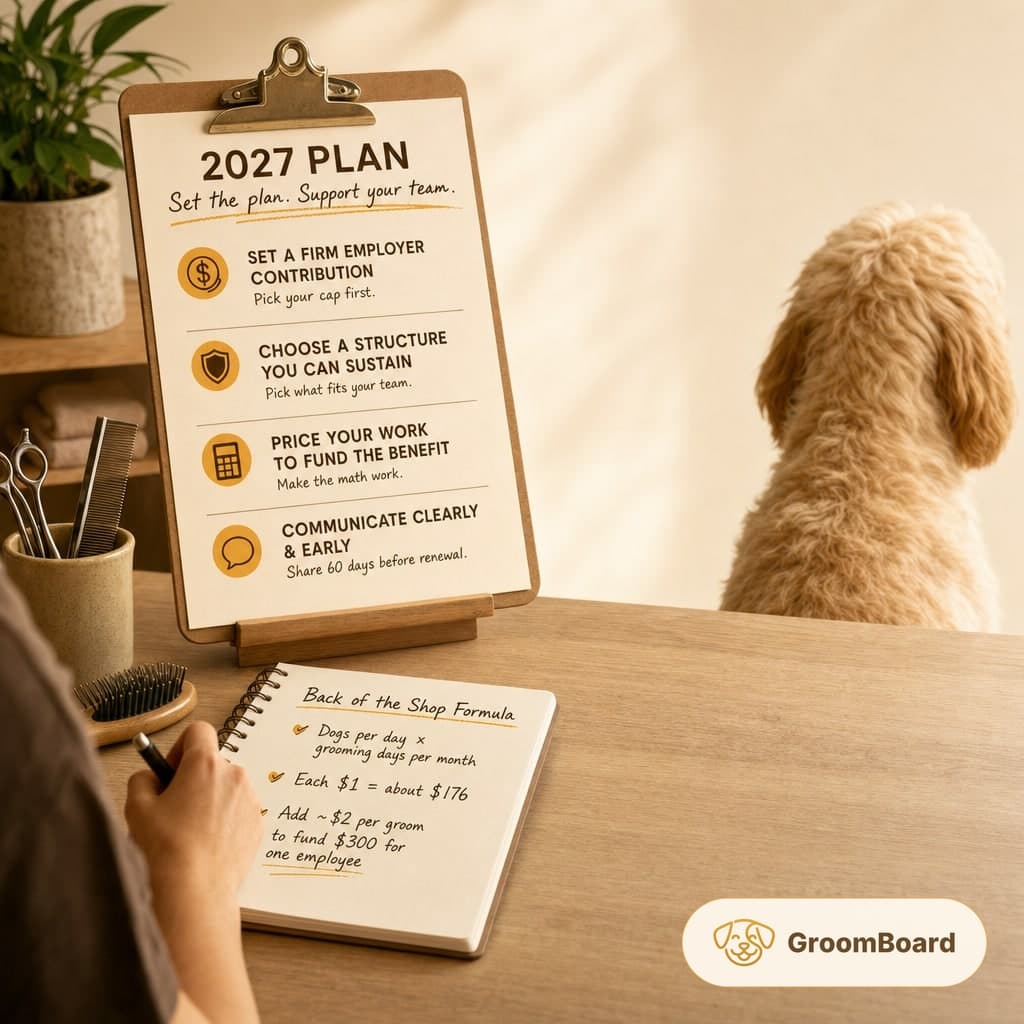
Tie your contribution to the number of grooms you complete each month so the math is real, not wishful. Use this back of the shop formula:
- Monthly grooms: dogs per day times grooming days per month. Example, 8 per day times 22 days equals 176 grooms.
- Each 1 dollar added to the average ticket brings about 176 dollars per month.
- To fund a 300 dollar monthly contribution for one covered employee, add about 2 dollars per groom. For two covered employees, add about 4 dollars. For three, about 6 dollars.
Blend this into your regular annual price review. If you have not adjusted in the last 12 months, a 3 to 8 percent increase plus a small add on for benefits is typical in our trade. Update written estimates, your online price ranges, and your service menu on the front desk.
Protect the revenue you already booked. Require a 25 to 50 percent deposit on online bookings and same day appointments, and enforce a clear no-show policy. If you use software with online deposits and SMS reminders, turn them on so fewer gaps hit your calendar. GroomBoard supports deposits through Stripe and reminder texts, which helps cash flow while premiums climb.
Eligibility, timing, and staff communication
Put your rules in plain language and share them 60 days before renewal. Copy and adapt this sample:
- Eligibility: Employees averaging 30 or more hours per week are eligible for health benefits.
- Waiting period: Coverage begins on the first of the month after 30 days of employment.
- Employer contribution: The salon pays up to 325 dollars per month toward employee only coverage. Dependents are employee paid. The employer contribution is reviewed annually and is a fixed dollar amount, not a percentage.
- Plan choice: The salon may change carriers or plan types at renewal to stay within the employer contribution.
- Enrollment: Open enrollment is held each year in the month before renewal. Midyear changes require a qualifying life event.
Keep a one page benefits summary in the break area and in your onboarding packet. During hiring, quote total compensation, not just hourly pay. Example, 20 dollars per hour plus a 325 dollar monthly health contribution and paid grooming tools allowance.
How to shop quickly and avoid surprises
- Start 90 days before renewal: set your employer cap and gather a clean employee census with ages and ZIP codes. Do not collect private health details.
- Ask a broker for three side by side options that fit your cap: one fully insured, one level funded, and one HRA with your defined contribution.
- Check provider networks near your salon so staff can actually use the plan.
- Confirm compliance basics for your size, including any continuation rules in your state and how you will handle required notices.
- Decide by 45 days out, then hold a 20 minute meeting to explain costs, timelines, and what action each employee must take.
Benefits are a retention lever you can control if you set a budget and buy to it. Rising premiums make delay expensive. A clear contribution, a fitting plan structure, and a small price adjustment per groom will let you keep coverage and keep your team.