
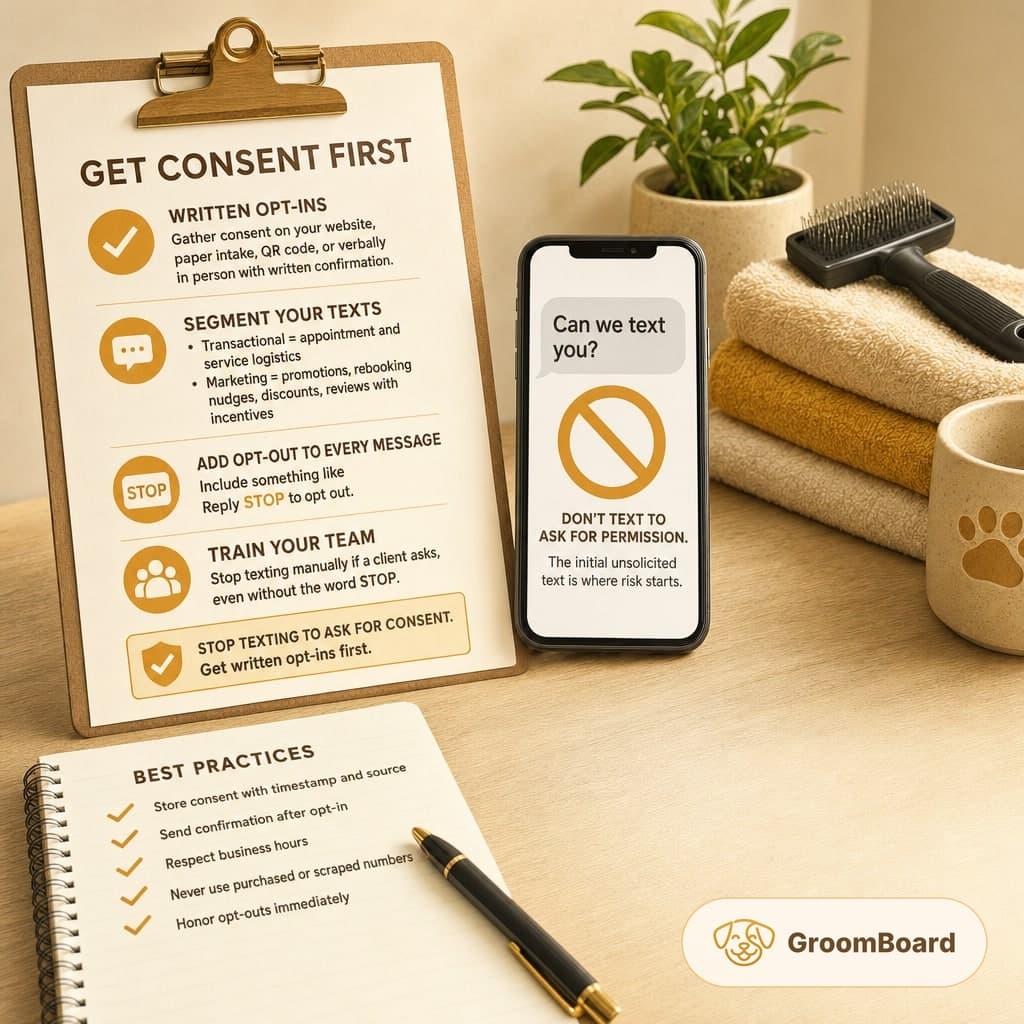
Stop texting to ask for consent, get written opt-ins first
What to do about it
- Do not send a permission request by SMS. Collect written opt-in before any marketing text.
- Separate transactional reminders from promotional texts and only send promos to clients who opted in.
- Add clear opt-out language to every message and honor STOP immediately.
- Standardize intake with unchecked consent boxes for transactional and marketing, stored with timestamp and source.
- Train staff that manual texts and bulk texts follow the same rules and that no purchased lists are allowed.
What happened and why it matters
The National Law Review reports that a court viewed a car dealership text that asked to communicate by text as potential marketing under the TCPA. If a simple permission request can count as marketing, a grooming business that relies on SMS for reminders, rebooking, policies, and promos has real exposure. Missteps can trigger complaints and costly per message penalties. The safe takeaway is simple: do not text a client until you already have explicit permission for the type of message you plan to send, and include a clear way to opt out every time.
What to change in your SMS program today
- Stop texting to ask for permission. Permission should be gathered on your website, paper intake, QR code form at check in, or verbally in person with written confirmation captured in your system. The initial unsolicited text is where risk starts.
- Segment your texts. Treat anything that encourages a purchase as marketing, for example rebooking nudges, holiday reminders, new services, discounts, referral asks, reviews with incentives. Treat pure service logistics as transactional, for example appointment confirmations, reschedules, arrival alerts for mobile, policies tied to an existing booking, weather closures.
- Only send marketing texts to clients with explicit written opt-in for marketing. If a client only consented to appointment notices, do not send promos or rebooking nudges.
- Add opt-out language to every message and honor it immediately. At minimum, include something like Reply STOP to opt out. Train staff to stop texting manually if a client asks, even without the word STOP.
- Keep messages short and purposeful. Limit marketing frequency, for example one or two per month to opted-in clients, and keep transactional messages to what is needed to run the appointment.
Get consent the right way
Use two distinct consent checkboxes that are unchecked by default. Store the selections, timestamp, and source.
- Transactional consent label example: I agree to receive appointment and policy texts from [Salon Name]. Message and data rates may apply. Reply STOP to opt out.
- Marketing consent label example: I agree to receive marketing and rebooking texts from [Salon Name]. Message and data rates may apply. Reply STOP to opt out.
Best practices to reduce risk and headaches:
- Send a confirmation text after opt-in that restates who you are, what the client signed up for, and how to opt out.
- Capture consent in the client profile, including who recorded it for in person signups. For paper forms, keep a photo or scan attached to the client record.
- Never use purchased or scraped numbers. Only text numbers your business obtained directly from the client.
- Respect business hours for non urgent texts, for example 9 a.m. to 7 p.m. local time. Urgent closure or day of timing updates can be outside that window, but keep it courteous.
Templates you can copy
Use these as a starting point and adjust to your software’s capabilities. Every message should identify your salon and include an opt out.
Transactional, appointment confirmation:
[Client], [Salon Name] confirming [Pet] on [Day Date] at [Time]. Reply C to confirm or call [Phone] to change. Reply STOP to opt out.
Transactional, mobile on the way:
[Client], [Salon Name] is on the way for [Pet]. ETA [Time Window]. Text here with gate or parking notes. Reply STOP to opt out.
Transactional, policy reminder tied to a booking:
[Client], [Salon Name] note for [Pet] on [Date]: mats may require a short clip for comfort. See policy here [short link]. Reply STOP to opt out.
Marketing, rebooking nudge, only to opted in clients:
[Client], it has been [X] weeks since [Pet]’s groom at [Salon Name]. Reserve your next spot here [short link]. Reply STOP to opt out.
Marketing, seasonal capacity alert, only to opted in clients:
Holiday schedule at [Salon Name] fills fast. Book now to hold your preferred date [short link]. Reply STOP to opt out.
Never put promotional language inside transactional reminders. If you add a coupon or booking nudge to an appointment reminder, you have converted it to marketing and it should only go to clients with marketing opt-in.
Train your team and check your vendors
- Manual texts count too. A groomer texting from a personal phone has the same obligations as your software. Use a shared number in your system when possible so opt-outs are honored consistently.
- Standard replies. Save quick replies for STOP received, HELP requests, and common questions so staff handle them uniformly.
- Vendor review. Ask your texting or booking provider how they capture opt-outs, whether STOP is auto suppressed, how consent is stored, and how to export logs. Tools that offer SMS reminders, including products like GroomBoard, should allow you to control message templates and include opt-out language.
- List hygiene. Remove numbers that bounce, complain, or never respond. If a client has not visited in over a year, consider reconfirming consent before any marketing outreach.
Record keeping and incident response
- Keep a consent log for every client you text: what they agreed to, when, where, and by whom. Retain screenshots or PDFs of your current consent wording each time you change it.
- Maintain a message log with timestamps and content. Ensure you can demonstrate that opt-outs are honored and that marketing messages only went to opted-in clients.
- If a complaint arrives, stop all texts to that client immediately, pull the consent and message history, and review your templates. Consider legal counsel if the complaint alleges a violation. This briefing is operational guidance and not legal advice.
For the legal development that prompted this, see reporting from The National Law Review.