
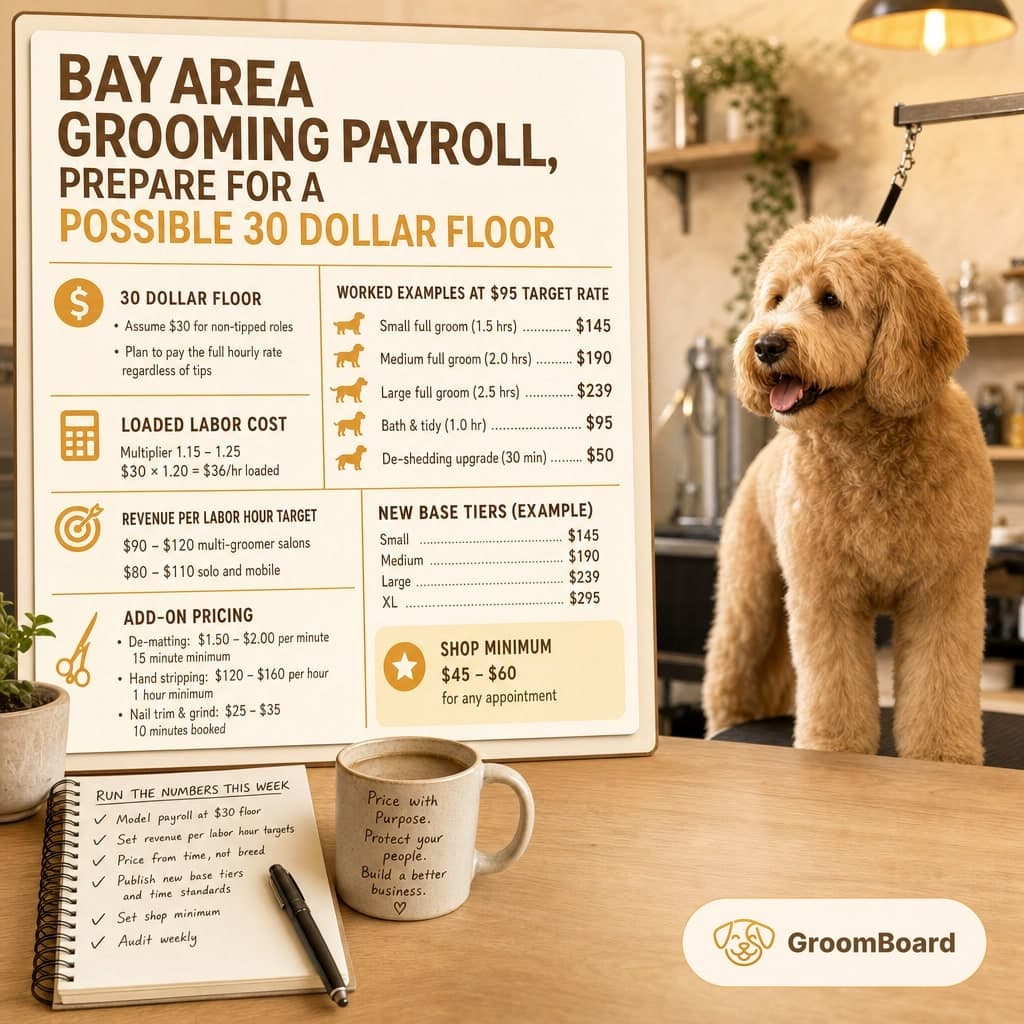
Bay Area grooming payroll, prepare for a possible 30 dollar floor
What to do about it
- Model a 30 dollar wage floor for bathers and reception and rebuild price tiers from labor time, not breed.
- Target revenue per labor hour of 90 to 120 dollars and set full groom prices accordingly.
- Shift groomers to hourly plus bonus or a lower commission with add-on incentives to control payroll creep.
- Lock in deposits of 25 to 50 percent and a 48 hour cancellation window to protect booked time.
- Publish new base rates and time standards, then audit ticket averages weekly until margins stabilize.
What happened, and why it matters
The Mercury News reports that an Alameda County study found a proposed 30 dollar minimum wage would add 33 million dollars to the county budget. For Bay Area grooming owners, this is a clear signal that a 30 dollar wage floor is on the table locally. If something like this lands in your city, bathers, reception, and assistants jump first, and margins tighten fast.
You do not need to wait for a vote to protect your shop. Model your payroll and pricing at a 30 dollar floor, publish clear time standards, and tune staffing so revenue per labor hour stays healthy.
Run the numbers this week
- Assume a 30 dollar floor for non-tipped roles. California does not allow a tip credit, so plan to pay the full hourly rate regardless of tips.
- Use a loaded labor cost multiplier of 1.15 to 1.25 for payroll taxes, insurance, paid time off, and uniforms. Example: 30 dollars times 1.20 equals 36 dollars per hour loaded.
- Set a revenue per labor hour target: 90 to 120 dollars in multi groomer salons, 80 to 110 dollars for solo and mobile. High cost markets will skew to the top end.
- Price from time, not breed. Price equals service minutes divided by 60, times your target rate, plus 3 to 7 dollars for products.
Worked examples at a 95 dollar target rate:
- Small full groom, 1.5 hours: 1.5 times 95 equals 143, round to 145.
- Medium full groom, 2.0 hours: 2.0 times 95 equals 190.
- Large full groom, 2.5 hours: 2.5 times 95 equals 238, round to 239 or 245.
- Bath and tidy, 1.0 hour: 95 dollars.
- De shedding upgrade: 30 minutes equals 48 dollars, round to 50.
Set add ons to reflect true labor:
- De matting: 1.50 to 2.00 dollars per minute with a 15 minute minimum.
- Hand stripping: 120 to 160 dollars per hour, 1 hour minimum.
- Nail trim and grind: 25 to 35 dollars, 10 minutes booked.
Pricing moves that preserve margin
- Publish new base tiers. Use weight and coat density. Example starting rates, Small 145, Medium 190, Large 239, XL 295. Make clear that heavy coats, severe matting, and behavior fees add to base time.
- Introduce a minimum ticket. Set a shop minimum of 45 to 60 dollars for any appointment so short visits still cover setup, payment, and cleanup time.
- Reprice at rebook. Honor existing quotes up to a posted effective date, then move all clients to the new chart. Avoid temporary surcharges. Clear base rates are easier to defend and to train staff on.
- Lift average ticket with structure. Bundle add ons into Good, Better, Best packages with a 10 to 15 percent spread. Example: Basic Bath 95, Coat Care 135, Coat Care Plus 165.
- Audit weekly. Track revenue per labor hour by staffer, rebooking rate, and add on take rate. If a service sits under target for two weeks, raise its price or add minutes to its standard.
Staffing and scheduling under a higher floor
- Role pay bands to retain experience: Bathers 30 to 33 dollars, Front desk 30 to 32 dollars with a small monthly bonus tied to rebooking and add on attachment, Assistants 30 to 31 dollars as a training wage with 60 day reviews.
- Groomer compensation: If you use pure commission, model a shift to hourly plus performance bonus or reduce commission a few points and add structured bonuses for add on revenue and same day rebooking. This reins in payroll when prices rise.
- Time standards to hit hourly targets: Small bath 45 minutes, Small full groom 90 minutes, Medium 2 hours, Large 2.5 to 3 hours, Doodle 3 to 4 hours. Enforce Ready By times to protect turnarounds.
- Assistant ratio: One bather for every two active grooming tables for mixed coats. For heavy deshed days, one bather per one to two tables keeps groomers on shears instead of tubs.
- Mobile owners: Set a per stop minimum, 150 to 180 dollars for bath only and 200 to 260 dollars for full groom, then add a zone fee for extended travel of 15 to 30 dollars.
Client communication you can use
Post the new chart and time standards, then send a plain language notice:
We are updating our base rates to reflect increased labor costs and to maintain appointment availability. Starting on the effective date, Small Full Groom starts at 145, Medium at 190, Large at 239. Severe matting, heavy undercoat, and special handling are billed by the minute. Existing bookings scheduled before the effective date keep their quoted price. We appreciate your trust and will always quote time and price before we begin.
At checkout, train staff to explain price by minutes and outcomes. Clients accept time based pricing more readily than abstract breed lists.
Cash flow, deposits, and policies
- Deposits: Take 25 percent on bookings over 150 dollars and 50 percent for multi dog, new clients, or 2 hour plus appointments. Make deposits non refundable inside 48 hours of the slot unless you can fill it.
- No show and late cancel: Charge the deposit or 50 percent of the service, whichever is greater, for cancellations inside 24 to 48 hours. Offer one courtesy waiver per year per household.
- Memberships and series: Sell a 3 pack at full price with a small perk, for example priority booking or free nail grinds, rather than discounting. Protect margin while smoothing cash flow.
- Tools: Use online booking with weight based tiers, SMS reminders to cut no shows, and online payments and deposits. Platforms like GroomBoard include these basics without forcing a POS change.
Bottom line: price from minutes, publish it, and hold your targets. If a 30 dollar floor comes to your city, you will already be operating at sustainable settings.