
Florida’s $15 minimum wage, pay and pricing changes to make now
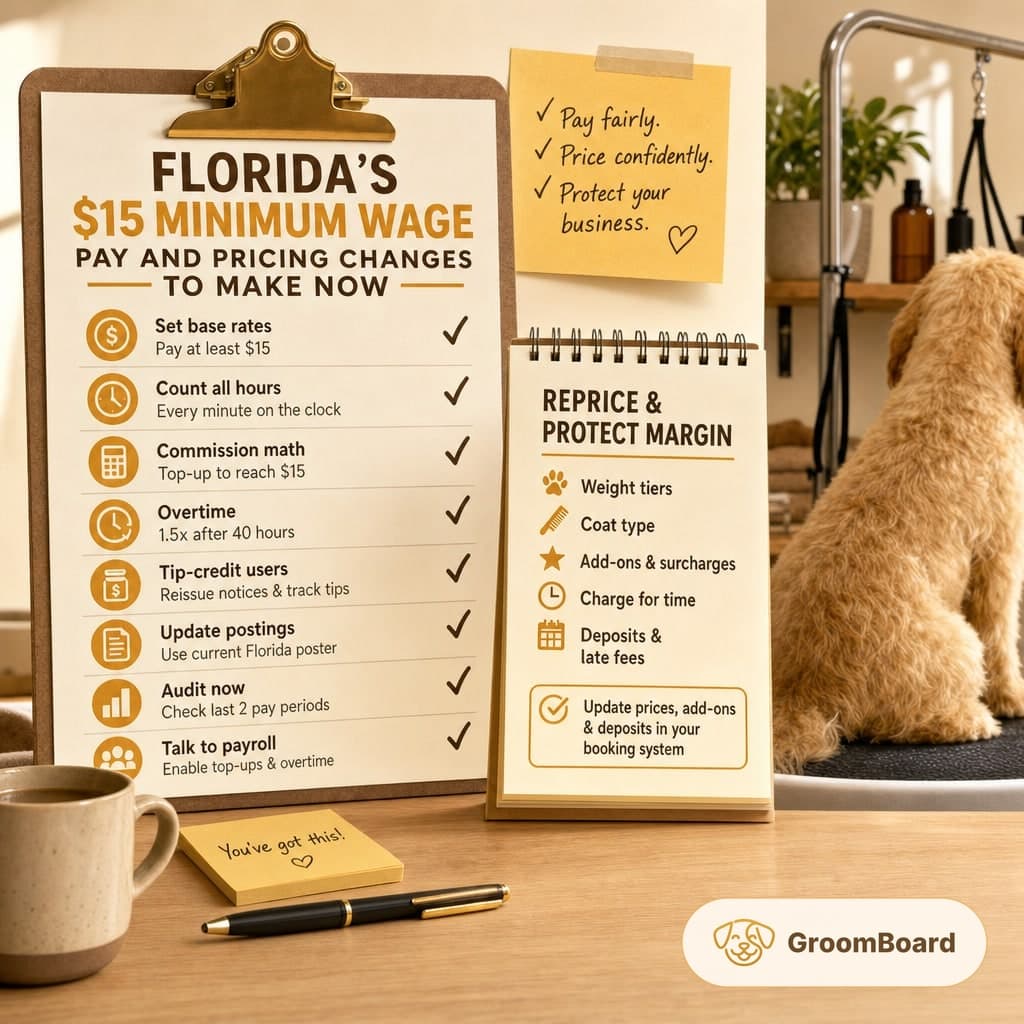
What to do about it
- Set every employee’s base rate to at least $15 and audit last two payrolls for compliance gaps.
- If you pay commission or per-dog, top up any short weeks so effective pay is at least $15 per hour worked, then recalc overtime from the regular rate.
- If you use a tip credit, reissue written tip notices and verify your cash wage plus tips now reaches the new floor.
- Lift prices or fees to cover the delta, typically 3 to 7 dollars per groom, and enforce add-on charges for extra work.
- Count all hours on the clock, including cleaning and drive time, at no less than $15, and tighten no-show and late pickup policies.
What happened and who it hits
Restaurant Business Magazine reports that Florida just became the 18th state with a minimum wage of at least $15. If you operate in Florida with employees, you now need to ensure every hour worked is paid at no less than $15, and you should recheck commission plans, tip handling, and your price list.
Immediate payroll and compliance checklist
- Set base rates: Any hourly or day-rate employee under $15 must be moved to at least $15 before the next payroll closes.
- Count all hours: Pay at least $15 for opening, closing, cleaning, laundry, training, meetings, kennel breaks, and for mobile operations, the on-the-clock drive time between stops.
- Commission or production pay: For each workweek, calculate the effective hourly rate. Formula: total earnings for the week divided by total hours worked. If the result is under $15, add a top-up to bring the average to at least $15 before calculating overtime.
- Overtime: When staff work more than 40 hours in a week, overtime is one and a half times the regular rate for that week. Commission and bonuses count in the regular rate. Example method: if a groomer earns 800 dollars over 45 hours, the regular rate is 800 divided by 45, the overtime premium owed is half that rate for 5 hours, on top of the straight time already paid.
- Tip-credit users: If you take a tip credit, reissue written tip notices, confirm your cash wage and tip accounting meet the new floor, and keep daily tip records. If you are not certain your setup is compliant, pay the full $15 in cash wages and treat tips as extra.
- Update postings: Replace your workplace minimum wage poster with the current Florida version and update your employee handbook pages on wages, tips, and overtime.
- Audit now: Pull the last two closed pay periods and test three employees, one in each pay type you use. Document the math and keep the worksheet with payroll records.
- Talk to payroll: Ask your provider to enable automatic minimum wage top-ups, regular rate overtime calc with commissions, and separate tracking of on-the-clock travel for mobile teams.
Reprice and protect margin
Labor is the biggest line in a grooming shop. If a bather at 13 dollars per hour moves to 15, that is 2 dollars more per hour, 16 dollars per day on an 8 hour shift. Spread across 8 dogs, that is 2 dollars per dog before taxes and payroll costs. Add employer taxes and the higher comp cost, and the safe move is a 3 to 7 dollar increase per groom, depending on your mix and speed.
- Set a clear price grid: Weight based tiers, coat type, and behavior surcharges. Use add-ons for matting, de-shed, flea, special handling.
- Publish a price floor: For example, small short-coat bath starts at X, full groom for small curly coat starts at Y. Put starts at in print and collect a deposit on high demand slots.
- Charge for time: Add a 1 dollar to 2 dollars per minute severe matting fee after the first 10 minutes, or a fixed 15 dollar to 30 dollar de-shed add-on per coat category.
- Late pick-up and no-show: Enforce a 25 percent to 50 percent booking deposit on new clients, a same-day cancellation fee, and a late pick-up fee after grace.
If you use GroomBoard or a similar system, update your price tiers, add-on items, and deposits so the new math is baked into every booking and reminder.
Rethink pay plans, commission, and tips
- Groomers on commission: Keep the headline percentage competitive, typically 40 percent to 50 percent of labor revenue, but build in an hourly floor of at least 15 dollars for all hours worked. Pay the greater of commission or floor each week, then compute overtime correctly when hours exceed 40.
- Bathers on hourly plus speed bonus: Pay 15 dollars per hour with a per-dog bonus above a daily target. For example, target 6 dogs, then 3 dollars per dog for every dog over target that passes QA. This aligns throughput without breaking compliance.
- Trainee steps: Start at 15 dollars, add 50 cents to 1 dollar after each defined skill block or every 60 completed grooms that meet time and redo standards.
- Tips: Run tips through payroll where possible to keep records clean. Share-out pools must be limited to eligible tipped roles and documented in writing. Never use tips to pay for breakage, shampoos, or tools.
Scheduling and operations to offset higher wage
- Standardize appointment lengths: Example target windows, 60 to 75 minutes for small full groom, 75 to 105 for medium curly, 105 to 150 for large double coat. Build buffers for cleanup and sanitation.
- Pre-screen at booking: Require current photos and weight, ask about coat condition and last groom date. Price and time blocks should adjust before the client arrives.
- Mobile routing: Count all drive time as paid work. Reduce dead time by clustering routes and setting minimums per stop, such as two pets per cul-de-sac or a higher single-pet travel fee.
- Inventory the non-billable minutes: Towels, blade swaps, check-in scripts. Shave 5 minutes per dog and you can cover most of a 2 dollar hourly increase without touching commission.
Client and team communication that works
- Price change notice: One paragraph on receipts and by text. State the date it takes effect, the reason as increased labor costs, and that add-ons reflect actual time and coat condition.
- Staff memo: Put the new base rates, overtime rules, tip handling, and how commission or bonuses interact with the 15 dollar floor in writing. Review it in a short meeting and have everyone sign an acknowledgment.
- Train the script: Front desk and techs use the same wording for matting fees, late pickups, and deposits. Consistency reduces disputes.
This change hits payroll now. Move quickly on wage floors and math, then make measured price and scheduling adjustments. One clean update beats months of patchwork.