
Seattle’s 2027 wage is set, update prices, pay and schedules now
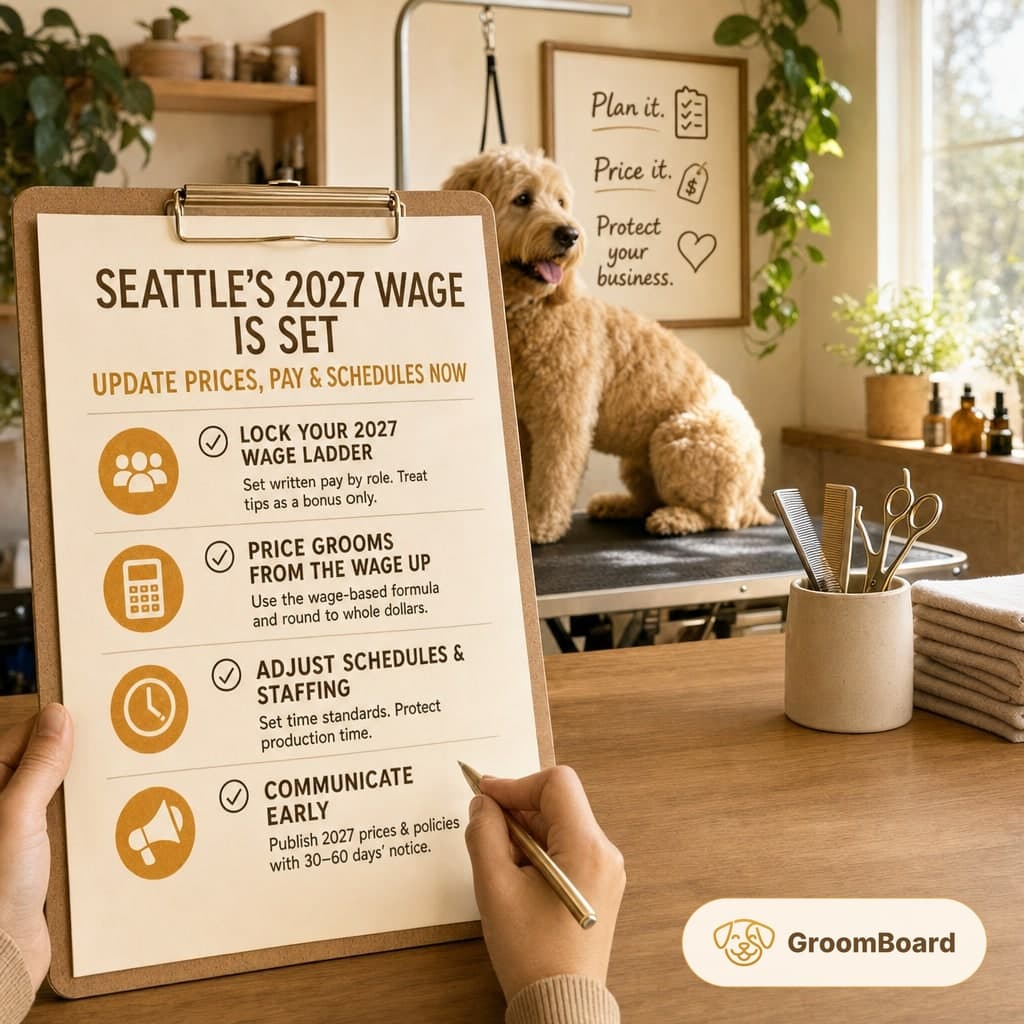
What to do about it
- Confirm which employer tier applies to you and align every role at or above the 2027 floor.
- Reprice each service with a wage based formula and round to practical menu prices.
- Publish a clear 2027 pay ladder and guarantees for commission based groomers.
- Tighten scheduling standards and staffing ratios to protect revenue per hour.
- Notify clients 30 to 60 days in advance and set deposits and fees that stick.
What happened and who it affects
The Seattle Times reports that Seattle has announced its 2027 minimum wage. If you operate inside Seattle city limits, this sets your floor for bathers, assistants and hourly guarantees for commission based groomers. Use it now to lock your 2027 price list, pay ladder and staffing plan before peak season fills the book.
Lock your 2027 wage ladder
Confirm which employer tier you fall under in the city rules, then set a written ladder so every role clears the 2027 floor. Treat tips as a bonus only. Do not rely on tips to meet base pay, since many jurisdictions prohibit counting tips toward minimum wage.
- Bather trainee, 0 to 60 days: minimum to minimum plus 1 dollar per hour, paid for all training hours.
- Bather I, fully productive on short coats: minimum plus 1 to 2 dollars per hour.
- Bather II, de shed and double coat competent: minimum plus 2 to 3 dollars per hour.
- Salon assistant or receptionist: minimum to minimum plus 1 dollar per hour depending on duties.
- Groomer, commission: 40 to 50 percent of groom price, with a written hourly guarantee that equals at least the 2027 minimum for all hours worked including down time. Audit weekly that commission beats the guarantee.
Budget employer taxes and insurance on top of wages. A simple planning rule is 10 to 15 percent of gross wages to cover payroll taxes and mandatory insurances, plus any benefits you offer.
Price grooms with a wage based formula
Reprice services from the wage up. Use this worksheet for each menu item, then round to whole dollar prices clients can remember.
- Step 1, find your hourly change. New 2027 base for the role minus current 2026 base. Example, if your groomer guarantee rises by 2 dollars per hour, your hourly change is 2.
- Step 2, multiply by labor hours per service. Typical labor hours: bath only small 0.8 to 1.0, small pet trim 1.5 to 2.0, medium full groom 2.0 to 2.5, large double coat bath 1.5 to 2.5, Doodle full groom 2.5 to 3.5.
- Step 3, add 20 percent to protect margin and taxes. Formula: Price add equals hourly change times labor hours times 1.2.
- Step 4, round sensibly. Favor 3, 5 or 10 dollar steps across size tiers.
Example, if your hourly change is 2 dollars and a small pet trim is 1.8 labor hours, the wage driven add is 2 times 1.8 times 1.2, which is about 4.32. Round your menu up by 5 dollars for that service tier.
Pressure test revenue per production hour. In a high cost city, target 70 to 90 dollars in revenue per productive hour per grooming workstation. If your new menu does not hit that on an average mix of dogs, adjust either time standards or prices.
Scheduling, staffing and productivity adjustments
Your most controllable lever is minutes per dog. Set written standards and schedule to them.
- Time standards: short coat bath 45 to 60 minutes with a bather, small to medium full groom 90 to 120 minutes, large double coat bath 90 to 120 minutes, Doodle 150 to 210 minutes depending on coat and behavior.
- Salon staffing: one productive bather can support two full time groomers if intake, drying and turnover are tight. If the mix skews to large double coats or Doodles, move to one bather per 1.5 groomers.
- Mobile: plan 3 to 5 dogs per day depending on drive time and size mix. Cluster neighborhoods and set a minimum service charge that reflects 2027 wages.
- Shift design: 8.5 hour shift with a 30 minute unpaid break yields about 8 production hours. Protect the first and last 15 minutes for setup and cleanup.
Track no shows and late arrivals closely. A single empty hour in a higher wage year erases a lot of margin. Double confirm holiday week appointments and require deposits on new clients.
Client communication and policy updates
Publish your 2027 price list and policies now, effective on the first 2027 appointment. Give 30 to 60 days notice to existing clients. Keep the message short and factual.
- Reason: citywide wage adjustment and increased operating costs.
- Effective date: first appointment on or after your chosen start date.
- Deposits: 25 to 50 percent on new clients and all appointments over two hours, collected by card on file.
- Late cancel fee: 50 percent inside 24 hours. No show fee: up to 100 percent.
- Existing 2027 prebooks: honored at the new 2027 menu.
If you use online booking and SMS reminders, update your service prices, deposit rules and canned messages before you announce. Systems that support online deposits, price tiers and automated texts, such as GroomBoard, make this faster to roll out.
Budget and timeline checklist
Build a simple 2027 payroll budget, then move on it quickly so clients are not surprised in December.
- This week: confirm your employer tier and the 2027 rate. Draft your wage ladder and groomer guarantee.
- Next week: reprice the full menu using the wage based formula. Round and sanity check revenue per hour.
- Within two weeks: update your booking system, offer letters and job postings with 2027 numbers.
- Within three weeks: send price change notices, update your website menu and front desk scripts.
- Before year end: audit the first two weeks of 2027 against targets, then tweak time standards or prices by service where needed.
Final reminder: commission groomers must still meet the hourly floor for all hours worked, and overtime rules apply on top of that. Audit weekly. Your margin in 2027 will come from minutes protected, deposits collected and prices that reflect the new wage.