
Dog Grooming Memberships and Packages: How to Price Them Without Losing Money
A dog grooming membership is a promise in both directions. The client pays a set amount every month, and you keep a spot for their dog on a fixed cycle. Done well, it fills your book months ahead and keeps coats out of the matting zone. Done badly, it hands a permanent discount to clients who were coming every four weeks anyway. This guide covers the formats salons actually sell, the math that decides which outcome you get, the legal edge of prepaid visits, and a set of terms you can copy.
If you have not set your base prices yet, start with our dog grooming price list template. Every number in this guide is a discount off that menu, so the menu has to be right first.
Five formats salons actually sell
"Membership" gets used for several different products: a grooming subscription, a bath club, or dog grooming packages paid up front. They behave differently on your calendar and your bank account, so name the one you mean before you price it.
1. Monthly membership
A fixed monthly charge for a set number of visits, usually one, plus perks such as a discount on extra services. These are the published plans we checked, with each salon's own page linked so you can read the current terms:
- Plush Paws in Orlando, Florida sells one bath and one full groom a month, priced per dog by size (from $99.90 a month for a small dog on its Premium plan, more for doodles and larger dogs). Its page says services do not roll over, each membership covers one dog, and members are told in advance of yearly rate increases.
- Scenthound, a franchise built on memberships, includes a basic hygiene package (bath, ears, nails, teeth and a wellness check) plus 25 percent off additional services, with prices set by each location.
- Sparkle Dog Care in Arizona tiers its plans from one visit a month to unlimited, with 20 to 30 percent off additional services, and lets members cancel any time after the first 60 days.
2. Unlimited bath clubs
A flat monthly fee for as many baths as the client wants, with full grooms sold at a member discount. Haute Dog Pet Spa in Lakeway, Texas prices unlimited baths by weight (from $37.50 a month for dogs up to 15 pounds) with 15 percent off grooms and one dog per membership. BarkSuds advertises unlimited baths from $45 a month with a 10 day cancellation notice. Note that "unlimited" can still have a limit: The Bark Spot in Utah caps baths at four a month for coat health and asks for 30 days notice before the next billing date to change or cancel.
3. Maintenance plans between full grooms
The full groom stays at full price, and the plan covers the small visits that hold the haircut together: a bath and tidy halfway through the cycle, a face and feet trim, or nails. The Bark Spot's Pawdicure plan is unlimited nail trims for $15 a month. This is often the safest format for a busy salon, because the visits are short, they keep long coats from tangling between grooms, and they do not discount your most expensive service.
4. Prepaid grooming packages
The client pays up front for a bundle of visits at a discount. Camp Bow Wow in Boulder, Colorado lists a 5 bath package at $198 against a single bath price of $44, which is $220 for five, so the package is 10 percent off. Its page says packages expire one year after purchase and become nonrefundable one month after purchase. Packages bring cash in early, but they do not recur, so the client has to decide to buy again.
5. Puppy packages and add on bundles
Puppy packages sell a short series of introduction visits that build up to the first full groom. Wanderfeld Groomers in the UK runs four visits, starting with the table, clipper vibration and scissors, adding a bath and dry, and ending with the first full groom. A puppy who learns the routine on a schedule is a future regular, which is the real point. Our guide to a positive first grooming visit covers what to do in those sessions.
Add on bundles group extras like teeth brushing, a facial and paw balm under one name and price. We cover those in detail in how to price grooming add on services, so here we only treat them as a membership perk.
Why members rebook on schedule, and why that matters more than the fee
The value of a membership is not the monthly charge. It is the visits that would otherwise have been missed or pushed back. A doodle that should come every 4 to 6 weeks but drifts to 10 or 12 arrives tangled, takes longer, and often ends in a shave down nobody wanted. PetMD's veterinary guide to matting puts it plainly: regular grooming is the best way to prevent mats, and mats pull on the skin and can trap moisture and debris that lead to irritation or infection.
For the salon, an on schedule dog means three things:
- A predictable groom. You can book the time the dog actually needs, instead of finding out at the table that a 90 minute slot needs two and a half hours.
- A steadier calendar. Members are booked weeks ahead, so slow weeks fill before they happen instead of after.
- Revenue you can forecast. Twenty members at $76.50 is $1,530 a month that arrives before the month starts, which makes payroll and supply orders easier to plan.
None of that requires a membership. Rebooking at checkout gets you much of it for free, and our client retention strategies guide covers the habits. A membership is worth adding when checkout rebooking is not enough to keep a group of clients on cycle.
The discount math: what 10 percent really costs
The tempting mistake is to see a 10 percent discount as costing 10 percent of revenue. It does not, because the comparison is not "same visits at a lower price". The comparison is "the visits this client would have made without the plan" against "the visits they make on it". Here is the break even in one line:
Extra visits needed per year = yearly discount ÷ what one extra visit earns you, where what a visit earns is the member price minus supplies, card fees and any commission you pay on it.
Worked through with assumed numbers (replace them with yours):
- Normal full groom price: $85 (assumed)
- Member discount: 10 percent, so the member pays $76.50 a visit
- Visits on the plan: 12 a year, so the yearly discount is 12 × $8.50 = $102
- Supplies per groom: $5 (assumed); card fees at Stripe's standard 2.9 percent plus 30 cents, about $2.52 on $76.50
- What one extra visit earns: $76.50 minus $5 minus $2.52 = $68.98
$102 ÷ $68.98 = about 1.5 extra visits a year. If the membership moves a client from 10 or fewer visits to 12, it pays for itself. If you pay a groomer 50 percent commission on each groom, an extra visit earns only about $30.73 and the break even rises to about 3.3 extra visits. That is why commission salons should discount less, or discount add ons instead of the groom. Our booth rent vs commission guide explains how pay structure shapes these margins.
Worked example: who joins decides whether you win
The table compares three clients with the same dog and the same $85 price, before and after joining a one groom a month plan at 10 percent off. "Contribution" is revenue minus supplies and card fees, using the assumptions above, with no commission. All inputs are assumptions for illustration, not industry data.
Client A is the trap. Your most loyal regulars are the first to say yes to a discount on what they already buy, and every one of them costs you money. Clients B and C are who the plan is for. Now add churn. Suppose 20 clients join (5 like A, 10 like B, 5 like C) and you lose an assumed 3 percent of members each month. You would average about 17 members over the year and have about 14 left at month 12. At full strength that mix adds roughly $3,800 a year in contribution; at an average of 17 members it is closer to $3,200, before you count the matting and overtime you avoid.
Two conditions sit under that number:
- You need open slots. Clients B and C add 75 visits a year between them, about one and a half a week. If your book is already full, each member visit replaces a full price visit and the discount becomes a pure cost. When you are full, raising prices is usually the better move.
- Members have to actually come. Track visits per member. A member who pays and never books looks profitable for a few months, then cancels angry, which brings us to breakage.
To test your own numbers, run your prices through the grooming pricing calculator, and use the add on revenue calculator to see what a member discount on extras would cost against the extra attach rate it might buy.
How to price a dog grooming membership
Bill monthly even when the cycle is not monthly. The formula:
Monthly fee = visits per year × normal price × (1 minus discount) ÷ 12
Price it per dog and by size or coat, exactly like your menu. Most plans we reviewed price by size or weight, and a flat fee for all dogs means your large doodles are subsidised by your small terriers. Keep perks that cost time small and perks that cost little generous: 20 percent off a facial or paw balm is cheap to give, while a free extra bath is a full slot.
Breakage: do not build the plan on visits nobody uses
Breakage is the industry word for prepaid value that is never redeemed. Some businesses quietly price packages expecting a share of visits to go unused. Do not. It rewards you for clients who drift away, which is the opposite of what the plan is for, and it turns every lapsed member into a complaint or a chargeback.
It can also be legally risky. The federal gift card rule in Regulation E, section 1005.20, which implements the gift card provisions of the CARD Act, generally bars an expiration date sooner than five years for gift certificates and store gift cards, and limits inactivity fees. Whether your package is covered depends on how it is written. The official commentary says a card redeemable for a specific service, such as a spa treatment, is generally not covered because it is not issued in a specified amount, while a card that states a dollar value, such as "a $50 value", is generally covered. So "5 baths" and "$220 of grooming" can fall under different rules.
State law can be stricter than the federal floor, and prepaid services may be treated differently from gift cards depending on the state. The National Conference of State Legislatures keeps a summary of state gift card statutes as a starting point. Before you put an expiration date or a "use it or lose it" rule on prepaid visits, check your state's current law or ask a local attorney. This guide is not legal advice.
Automatic renewal rules apply to monthly memberships
A membership that charges a card every month is an automatic renewal, and many states regulate those. The FTC's nationwide "click to cancel" rule was vacated by the Eighth Circuit in July 2025, but the same analysis notes that more than half the states have their own automatic renewal laws. California's, expanded from July 1, 2025, requires express consent to the renewal terms, cancellation through the same channel the client used to sign up, an annual reminder, and records of consent. The safe habit everywhere: clear terms before the first charge, a signed authorization, and cancellation as easy as joining.
Membership terms template you can copy
Edit the bracketed parts, have the client sign before the first charge, and give them a copy. Check the cancellation and rollover clauses against your state rules.
- What is included. This membership covers [one full groom / one bath and tidy / unlimited nail trims] per billing month for one dog, [name], at the [size or coat] level. Add ons are [percent] off and paid at the visit.
- Billing. The membership fee of $[amount] is charged to the card on file on the [day] of each month, starting on [date]. I authorize these recurring charges until I cancel.
- Booking. Member visits are booked at least [number] weeks ahead. We will offer your next visit at checkout.
- Unused visits. One unused visit may carry into the next billing month and must be used within it. Visits do not accumulate beyond that, and they have no cash value.
- Missed appointments. A no show or a cancellation with less than [hours] hours notice uses that month's visit.
- Pausing. You may pause up to [number] months per calendar year for travel, surgery or illness. No fee is charged while paused.
- Cancellation. Cancel any time by [phone, text, email or online form], with [number] days notice before the next billing date. There is no cancellation fee. If [name] passes away or is rehomed, the membership ends right away and we stop billing.
- Multiple dogs. Each membership covers one dog. Additional dogs in the same household get their own membership at [discount] off.
- Coat condition. If [name] arrives matted, dematting or a shave down is quoted and charged separately, at the member discount.
- Price changes. We review prices once a year and will give you at least [number] days written notice of any change, with the option to cancel before it applies.
For the cancellation and no show language itself, our grooming cancellation policy template has three versions you can drop in.
How to launch to your existing clients
- Start with one format and one service. A single monthly plan for doodles and other high maintenance coats, or a bath and tidy plan between grooms, is enough to learn from.
- Count your capacity first. Decide how many member slots a month you can protect, and cap memberships at that number. A waitlist is better than bumping full price clients.
- Pick who you offer it to. Pull a list of clients whose dogs have gone past their ideal interval two or more times this year. Those are your B and C clients. Do not run a blanket campaign to your whole list, because your A clients will sign up first.
- Make the offer at checkout, in person. Something like: "Bella looked her best today because she came in at six weeks. If you want her on that schedule all year, we have a monthly plan that keeps her spot booked and takes 10 percent off." Then hand over the written terms.
- Get the signature and the card authorization. No verbal memberships. The terms above protect you as much as the client.
- Review after six months. Compare each member's visits against their history. If most of your members are A clients, raise the member price, shrink the discount, or move the discount from the groom to add ons.
Running it day to day
Two jobs keep a membership honest: charging the card on schedule, and keeping the dog on cycle. GroomBoard does not bill memberships or packages, so the recurring charge runs through your card processor's recurring billing tool, and you keep a short list of members, start dates and visits used.
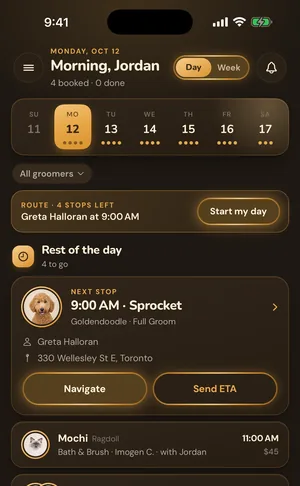
The second job is where your booking system matters. In GroomBoard, marking a groom completed proposes the next appointment at that dog's usual interval, so the member leaves with their next visit booked, and SMS reminders go out before it. You can also take deposits and keep a card on file for no show fees, which pairs with the missed appointment clause above. Plans and what each includes are on our pricing page.