
How to Raise Your Grooming Prices Without Losing Clients
If you haven't raised your prices in the last 12 months, you've already taken a pay cut. Supply costs, shampoo, blades, electricity, all of it costs more than it did a year ago. Raising your grooming prices is not a favor to yourself; it's basic business maintenance. The groomers who hesitate longest are usually the ones running the leanest margins, serving the most difficult dogs, and burning out the fastest.
The good news: most clients don't leave over a price increase. They leave when it feels sudden, unexplained, or disrespectful. Handle the communication right and your retention rate will barely move.
Know Your Numbers Before You Set a New Rate
Don't guess at a number because it "feels right." Start with your actual cost per appointment. Add up your monthly fixed costs, rent or home studio overhead, insurance, software, utilities, and divide by the number of appointments you complete per month. Then add your variable costs per dog: shampoo, conditioner, blade wear, disposables. A rough per appointment cost for a solo groomer running 100 to 120 dogs a month typically lands between $8 to $15 in consumables alone, before overhead.
From there, look at your local market. In most midsize Canadian and U.S. cities, a full groom on a medium sized dog (think Cocker Spaniel, Schnauzer, Bichon) runs $70 to $95. In metro markets like Toronto, Vancouver, or New York, $95 to $130 is standard. If you're sitting $15 to $20 below those benchmarks, you have room, and reason, to move.
Also pull your own data. What percentage of your clients are full groom regulars on a 6 to 8 week schedule? What's your rebooking rate? If 80%+ of your clients rebook consistently, you have a loyal base that's less price sensitive than you think.
Decide on the Increase Amount
A 10 to 15% increase is the sweet spot for most groomers doing an annual adjustment. On a $75 groom, that's $7.50 to $11.25, which most regular clients absorb without blinking. If you're severely underpriced and need a larger correction, consider a two step increase: raise $10 to $15 now and another $5 to $10 in 6 months. Stacking two moderate increases is easier for clients to accept than one large jump.
Be consistent. Raise prices across the board, not selectively. Charging one client $85 and another $70 for the same service and breed creates confusion and resentment when clients compare notes, and they do.
Time It Right
The best windows for a price increase:
- January/February: New year, new rates. Clients expect it and it aligns with annual business reviews.
- After a slow season: Increasing prices going into spring, your busiest season, means you capture higher revenue at peak volume immediately.
- After a service upgrade: New tub, new dryer, extended appointment times, added services like teeth brushing or ear cleaning. A tangible improvement makes the increase easier to justify.
Avoid raising prices in the weeks before or after major holidays. Clients are already stressed about spending, and a price notice landing in December reads poorly.
How to Communicate the Increase
Notify clients at least 30 days before the new rate takes effect. Earlier is fine; last minute is not. Here's exactly what to include in your message:
- The current price
- The new price
- The effective date
- A one sentence reason (cost of business, not an apology)
A sample SMS or email notice that works:
"Hi [Name], just a heads up that starting [Date], our grooming rates will be increasing slightly to reflect rising supply and operating costs. [Dog's name]'s full groom will move from $75 to $85. Your next appointment on [Date] will still be billed at the current rate. Thanks for being a loyal client, we really appreciate you."
That's it. No lengthy justification, no profuse apology, no three paragraphs of padding. Groomers who overexplain come across as unsure of themselves, and clients sense that uncertainty. A confident, matter of fact notice signals that this is a normal part of running a professional service, because it is.
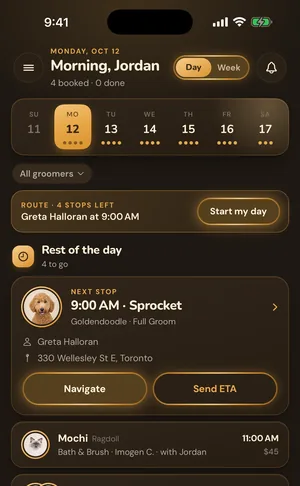
If you're managing a client list of any size, sending individual or segmented messages is much easier when your client data is in one place. A tool like GroomBoard keeps every client's contact info, dog details, and appointment history accessible so you're not hunting through spreadsheets when it's time to send a rate notice.
Handle Pushback Without Caving
Some clients will respond. Most won't. Of those who do, the majority just want to be heard, not to actually negotiate. Here's how to handle the most common responses:
"That seems like a big jump."
Acknowledge it, don't backpedal: "I understand. I kept my rates flat for two years, so this is playing catch up a bit. I'm still competitively priced for the area, and the quality of the groom isn't changing."
"I might have to find someone cheaper."
This one stings, but don't fold. A client willing to switch groomers over $10 is a client who will leave you again the next time someone undercuts you. Wish them well genuinely: "I completely understand, budget matters. If you ever want to come back, we'd be happy to have you." Many return within 3 months when the cheaper option doesn't work out.
"Can you keep my rate the same since I've been coming for years?"
This is the hardest one, especially with long term clients. The honest answer is no, grandfathering individual clients creates pricing chaos and resentment among your newer clients who are paying full rate. You can soften it: "I really value your loyalty, and that's part of why I gave everyone a full month's notice. The new rate is still fair for the work, and I'd love to keep seeing [dog's name]."
What to Do With the Clients Who Leave
Some will go. Plan for it. A 5 to 10% client loss is normal and expected with any price increase. The math usually still works in your favor: if you raise prices 12% and lose 8% of clients, your revenue goes up and your appointment volume drops slightly, meaning less physical wear on your body and more time per dog.
The clients who leave over a modest increase tend to be your most price sensitive and sometimes your most difficult. The ones who stay are your core base. Use the reclaimed appointment slots to rebook existing clients more frequently or to take on higher value new clients who found you through referrals or online booking.
If you want to shore up retention before and after a price change, the strategies in Pet Grooming Business Software: The Complete Guide to Reducing No Shows, Filling Empty Slots, and Increasing Revenue (2026) are worth reviewing, particularly around automated reminders and how consistent communication affects rebooking rates.
Raise Add On Prices at the Same Time
If you're already updating your base groom pricing, update your add ons simultaneously. Teeth brushing, deshedding treatments, blueberry facials, nail grinding, anal gland expression, these are often priced once and forgotten. If your deshed treatment is still $20 but takes 20 to 30 extra minutes on a double coated dog, that's the first place your profitability is leaking.
A deshed on a heavy shedding Lab or Husky should be $30 to $50 depending on your market. Nail grinding is a 5 minute add on that often goes for $10 to $15 on top of a clip. If you haven't reviewed your complete add on menu recently, doing so alongside a base price increase is efficient and makes the whole update feel like a deliberate business decision rather than a reactive one.
Build the Habit of Annual Price Reviews
The groomers who dread price increases the most are usually the ones who do them least often. If you review and adjust rates every 12 months, even just 5 to 8%, clients normalize it. It becomes expected rather than alarming. Set a calendar reminder for the same month every year. Pull your costs, check local market rates, and make a decision.
Think of groomers who charge $120 for a Standard Poodle full groom in a major metro. That price didn't appear overnight, it was built through consistent annual adjustments, service quality, and confidence. If you're still trying to figure out the right pricing approach for specific breeds, the How to Groom a Standard Poodle: Complete Guide for Professional Groomers covers time expectations and techniques that directly inform how you should be pricing that appointment.
Similarly, if a Yorkshire Terrier full groom is taking you 90 minutes because the coat is damaged or matted, your pricing needs to reflect that. The How to Groom a Yorkshire Terrier: Complete Guide for Professional Groomers is a useful reference for understanding where time actually goes on certain breeds, which is the foundation of accurate pricing.
The Mindset Shift That Makes This Easier
Grooming is skilled trade work. You are handling animals that bite, scratch, and panic. You use specialized equipment, maintain certifications, and work physically demanding hours. A plumber doesn't apologize for raising their hourly rate. Neither should you.
Your prices are not a reflection of what you think you're worth as a person, they're a reflection of what the service costs to deliver at a professional level. When you frame it that way internally, communicating increases to clients becomes much less emotionally loaded.
If you're building out the systems side of your business alongside better pricing, booking, reminders, client records, it's worth taking a look at what modern grooming software can handle for you. GroomBoard's Solo plan starts at $19/month and includes online booking, SMS appointment reminders, and client and pet management. You can start a free trial with no credit card required and see whether it fits your workflow.
Raising your grooming prices is not the last resort of a desperate business owner. It's the routine practice of a professional who knows their costs, respects their time, and runs a sustainable operation. Do it consistently, communicate it clearly, and most of your clients will follow you without a second thought.