
Swipe fee settlement has gaps, groomers should audit card costs
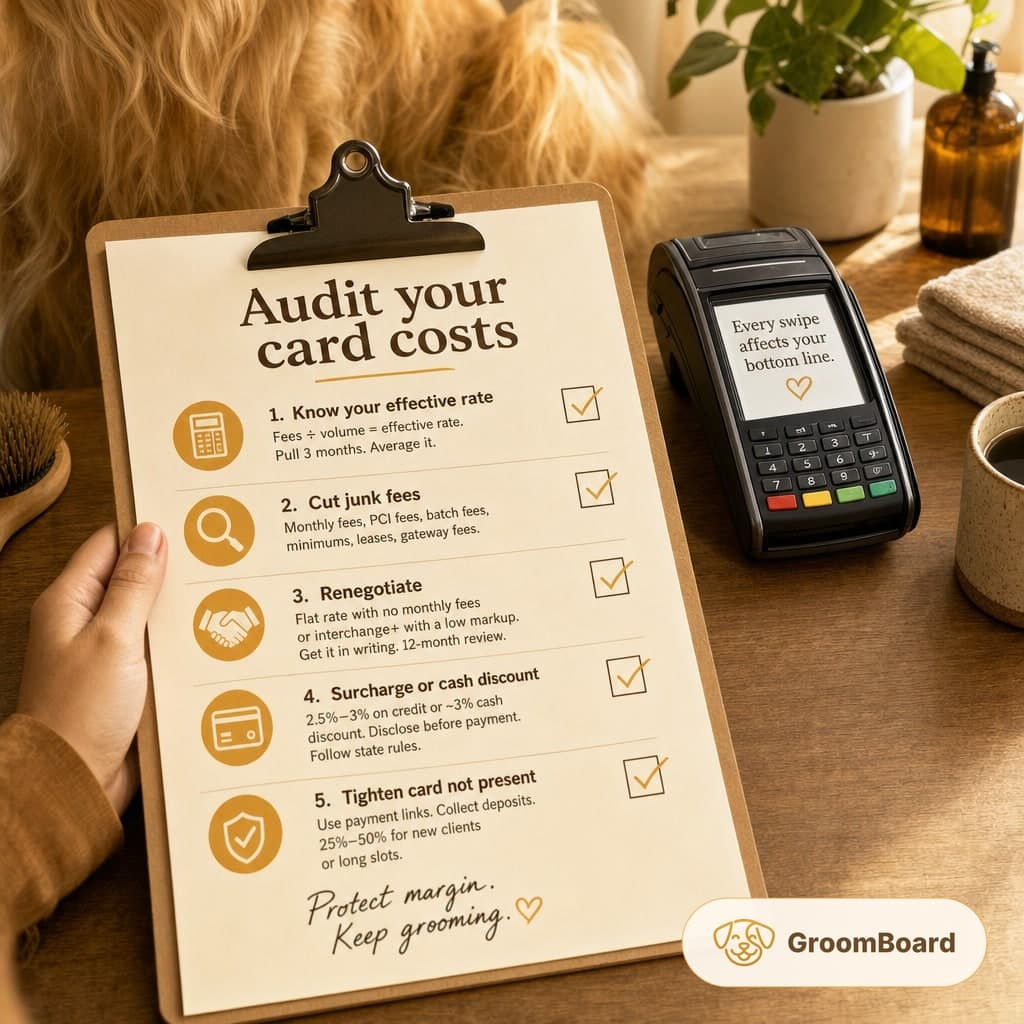
What to do about it
- Calculate your true effective rate for the last three months and set a target you will hold your processor to.
- Eliminate statement junk fees, and ask for a simpler plan if you cannot justify each line item.
- Adopt a compliant surcharge or cash discount only if it keeps you competitive and is clearly posted.
- Reduce keyed and card-on-file transactions by using payment links or online checkout for deposits and balances.
- Use deposits and clear policies to lower no-shows so you are not paying fees on wasted appointments.
What happened and why it matters
Convenience Store News reports that merchants are calling out loopholes in a credit card swipe fee settlement. If the settlement does not materially lower your rates, you still absorb the same fee drag on every groom. Treat this as a deadline to get your processing house in order. Read the brief from Convenience Store News for the high level development, then act on the numbers you can control in your salon or rig.
Start with your effective rate
Pull the last three months of statements. For each month, divide total fees by total processed volume. That is your effective rate. Example: 3,200 dollars in fees on 110,000 dollars volume is 2.91 percent. Average the three months to smooth out spikes.
Set targets that fit your mix. If most transactions are in person with chip or tap, many small salons aim to keep the effective rate in the mid twos. If a big share is card not present or card on file, expect a higher blend because risk pricing applies. Flat rate plans commonly quote a percent plus a per transaction fee. With a 95 dollar average ticket, a 2.9 percent plus 30 cents plan costs about 3.06 dollars per sale. Use that as a sanity check against your statement.
If your effective rate is over 3 percent and most of your volume is swipe, chip, or tap, build a plan to either negotiate, simplify, or steer tender to reduce cost.
Cut junk fees and renegotiate
Line items that deserve scrutiny:
- Monthly account, statement, or customer service fees.
- PCI non compliance or “regulatory” fees. Complete your PCI questionnaire and ask for non compliance charges to be removed once you pass.
- Batch fees and monthly minimums, often legacy charges that add up.
- Terminal lease charges. If you are paying a long lease, price out a one time purchase instead.
- Address verification, gateway, or payment link fees that duplicate what you already pay elsewhere.
Call your processor with your three month average effective rate and a target. Ask for one of two paths. Either a flat rate with no monthly fees and clear per transaction pricing, or an interchange plus plan with a simple markup stated as a percent and a per transaction fee. For many small operators, a markup under half a percent and under 15 cents per transaction can be competitive, but volume and risk move this number. Get quotes you can compare apples to apples.
Ask for a 12 month review date in writing. If your average effective rate creeps above the target and your mix has not changed, they will revisit pricing or you will shop the account.
Decide on surcharging or steering
If your local rules allow it, a surcharge or a posted cash discount can protect margin. This is a business decision, not just a compliance task.
- Compliance basics: disclose the fee or discount before payment, never apply a credit surcharge to debit, and post the policy at the counter and on invoices. Some states restrict surcharging and signage, check your state rules and your processor’s network guide before you launch.
- Numbers that work in grooming: many salons that choose to surcharge set 2.5 to 3 percent on credit only, capped at the cost of acceptance. Cash discount setups often list a standard price and a lower cash price that is about three percent less. Build the math into your menu so posted prices make sense to clients.
- Messaging that reduces friction: credit has a small processing fee so we can keep base prices fair for everyone. Offer a visible cash or debit option so clients feel they have a choice.
Test for 60 days. If you field constant price objections or see a dip in rebooking, remove the policy fast. If it is quiet and your effective rate drops, keep it.
Tighten card not present to save fees and chargebacks
Card not present rates are higher and disputes are more expensive. Reduce exposure:
- Use payment links or an online checkout instead of keying cards by phone. You get address and CVV checks that help on disputes.
- Collect deposits for new clients or long slots. Twenty five to fifty percent is common. Pair with a clear cancellation window, for example 24 to 48 hours, so you are not paying fees on no show time.
- Store cards on file with client consent and only charge what your policy allows. Send receipts automatically. Avoid manual keyed entries.
- Batch out daily and refund to the original card promptly to avoid extra fees.
If you use software that supports online payments, such as GroomBoard with Stripe, set deposits and payment links so fewer cards are keyed by hand. This usually lowers your blended cost and gives cleaner records when a client disputes a charge.
Quick operational tweaks for mobile rigs and salons
- Connectivity: use readers that can take chip and tap reliably on the driveway. If signal is weak, use offline mode where available and avoid later key entry.
- Average ticket: round add ons to reduce small separate charges that get hit with per transaction fees. Add nail grind or de shed to the main ticket, not a second swipe.
- Tips: accept tips on the same transaction so you do not pay another per item fee.
- Training: one staff member who enters a wrong keyed amount can cost you all month. Review the flow and limit who can key cards.
Your margins will not be saved by a headline. They move when you measure, make a clear policy choice, and hold your processor to a number. Put card costs on your checklist this week.