
Texting clients just got riskier, get consent and audit now
What to do about it
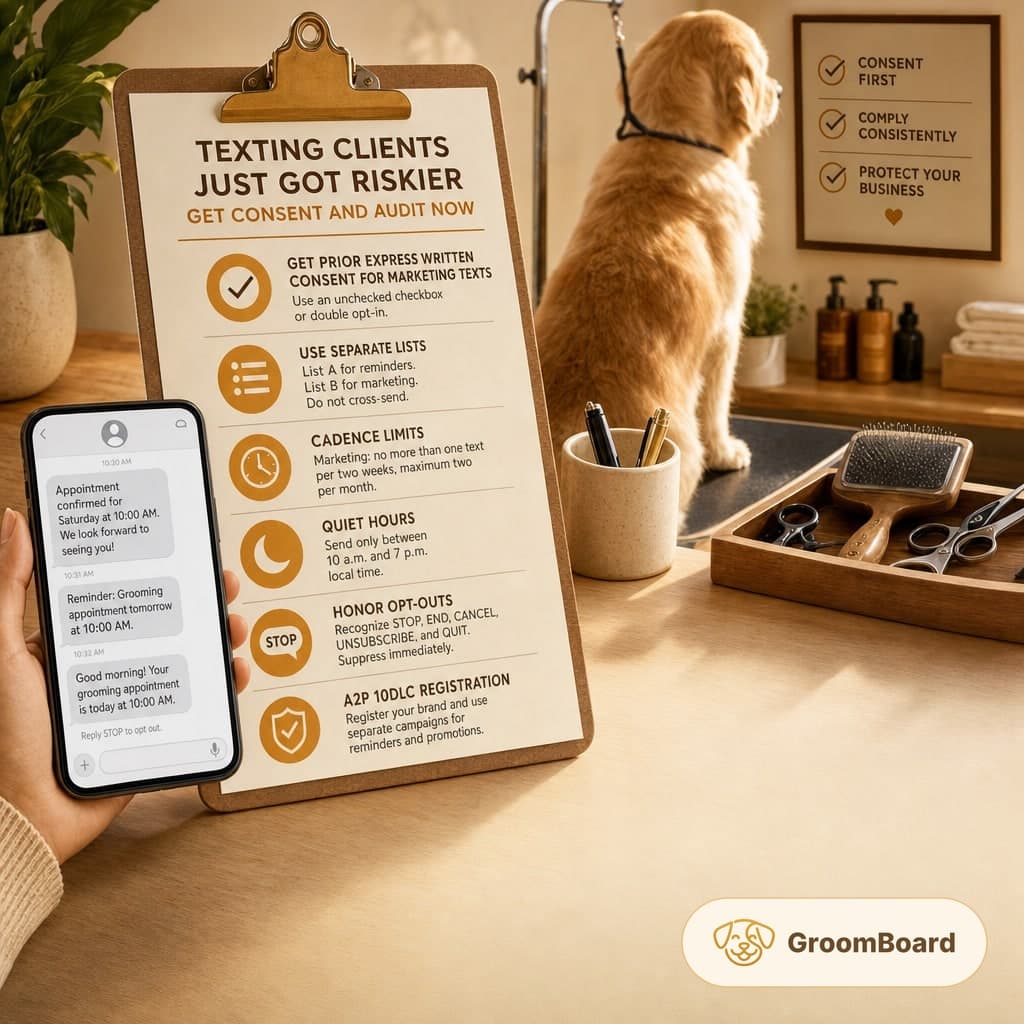
- Get prior express written consent for any marketing text, no exceptions.
- Keep reminders and customer care texts strictly non-promotional and separate lists.
- Store consent proof and message logs for at least four years.
- Register and label campaigns, and audit your SMS vendor quarterly.
- Update contracts to require TCPA compliance, logs, fast opt-outs, and indemnity.
What happened and why groomers should care
The National Law Review reports that a court found an insurance administrator could plausibly be treated as having initiated texts and that the established business relationship exemption did not apply. That combination puts senders and the businesses that hire them on the hook. If you send SMS reminders or promotions, you cannot assume your prior dealings with a customer protect you, and you may be responsible for texts your vendor triggers. Read the source report from The National Law Review for legal detail.
Operationally, treat every marketing text as high risk unless you have clear, documented consent and tight vendor controls. Below is a playbook sized for a six to ten dogs per day shop.
Marketing vs reminder texts, and the consent you need
- Transactional or customer care texts: appointment confirmations, day-before reminders, arrival windows for mobile, pick-up ready notes, vaccine expiry reminders. Keep these strictly informational. No upsells, no links to sales pages, no discount mentions.
- Marketing or promotional texts: new services, openings blast, seasonal promos, rebooking drives, referral pushes, anything that encourages a purchase.
Guidance: get prior express written consent for any marketing text. Capture it via an unchecked checkbox on your website or intake form, or via a double opt-in flow. For transactional reminders, obtain consent to receive appointment-related texts during onboarding, and keep those messages free of marketing content.
Opt-in playbook and practical settings
- Use separate lists. List A for reminders and customer care. List B for marketing. Do not cross-send.
- Web form consent language for marketing should clearly state that the customer agrees to receive marketing texts, frequency estimate, that consent is not a condition of purchase, and how to opt out. Include STOP and HELP instructions.
- Double opt-in for marketing. After the checkbox, send a confirmation text asking the client to reply YES to join promos. Only add them to List B after a YES reply.
- Cadence limits. Marketing: no more than one text per two weeks, with a hard cap of two per month. Transactional: one confirmation at booking, one reminder 48 hours before, and an optional same-day morning nudge. Mobile route updates should be limited to arrival window changes.
- Quiet hours. Send only between 10 a.m. and 7 p.m. local time for the recipient. Set your tool to respect local time zones.
- Keywords and opt-outs. Recognize STOP, END, CANCEL, UNSUBSCRIBE, and QUIT. Suppress immediately and send a one-time confirmation that the opt-out is complete, then stop all further texts except a single message to process re-enrollment if they initiate it.
- A2P 10DLC registration. Register your business brand and declare separate campaigns for reminders and promotions with your SMS provider. Use clear campaign descriptions that match what you send.
Example consent text for a website checkbox, use your own branding: I agree to receive marketing texts about grooming services and offers at the number provided. Message frequency varies. Reply STOP to opt out. Message and data rates may apply. Consent is not a condition of purchase.
Vendor risk controls and contract must-haves
If a court can view a vendor as the sender, you need vendor paperwork and controls that protect you. Add these to any texting or software agreement, or to a one-page addendum:
- Compliance warranty. Vendor warrants their platform supports TCPA compliant consent capture, opt-out handling, and message logs.
- Indemnity. Vendor indemnifies your shop for claims arising from their failure to honor opt-outs, maintain suppression lists, or send within your configured campaign types.
- Data and logs. Vendor provides exportable consent records, campaign definitions, send logs, and opt-out logs within two business days of request.
- Subprocessors. Vendor must disclose any downstream texting carriers or subcontractors and remain responsible for them.
- Controls. Your account must allow separation of transactional and marketing campaigns, configurable quiet hours, and opt-in gating so promotions cannot be sent to non-consenting numbers.
- Incident notice. Vendor notifies you within 48 hours of any widespread opt-out failure or unauthorized send.
Operational guardrails matter as much as contract language. Limit who can send marketing texts to the owner or manager. Require a second person review before any blast. Use templates that have been pre-approved for wording.
Recordkeeping, auditing, and staff workflow
- Consent evidence. Store for each number: phone number, consent type, timestamp, source page or form version, exact consent wording used, IP or staff initials if captured in person, and double opt-in reply if used. Keep records for at least four years after the last text to that number.
- Message logs. Keep sent content, campaign name, send time with time zone, delivery status, and any replies.
- Suppression list. Maintain a master do-not-text list that is checked before every send, including numbers you manually add for complaint handling.
- Quarterly audit. Randomly sample 20 marketing recipients. Verify that each has written consent on file and that quiet hours were respected. Correct and retrain on any miss.
- Staff script at intake. Ask for two separate permissions, first for appointment-related texts, then for promos. If the client says no to marketing, still capture yes or no to reminders.
If you use grooming software with SMS features, configure separate campaigns and consent capture. For example, GroomBoard supports SMS reminders and online booking, and you control the content and timing. Use that to keep reminders informational and your promos limited to clients with written opt-ins.
Quick settings you can implement this week
- Add a marketing opt-in checkbox to your online booking or intake form, unchecked by default.
- Turn on a double opt-in step for promotions. Require a YES reply before adding anyone to the promo list.
- Split your templates. Two reminder templates, booking confirmation and 48 hour nudge. One promo template with your legal footer and STOP language.
- Schedule windows. Set sends to 10 a.m. to 7 p.m. local time for clients, Monday to Friday for promos.
- Create a one page SOP that says who may send texts, what lists exist, how opt-outs are processed, and where logs live. Train the team in a 15 minute huddle.
- Ask your SMS vendor for proof of your brand and campaign registration, and for an export of your current suppression list and consent logs.
Texting still fills schedules and cuts no-shows. After this ruling, it just requires clean consent, clean content, clean records, and a vendor you can prove controls.