
Canada shifts TFW rules for small employers, plan low-wage hiring
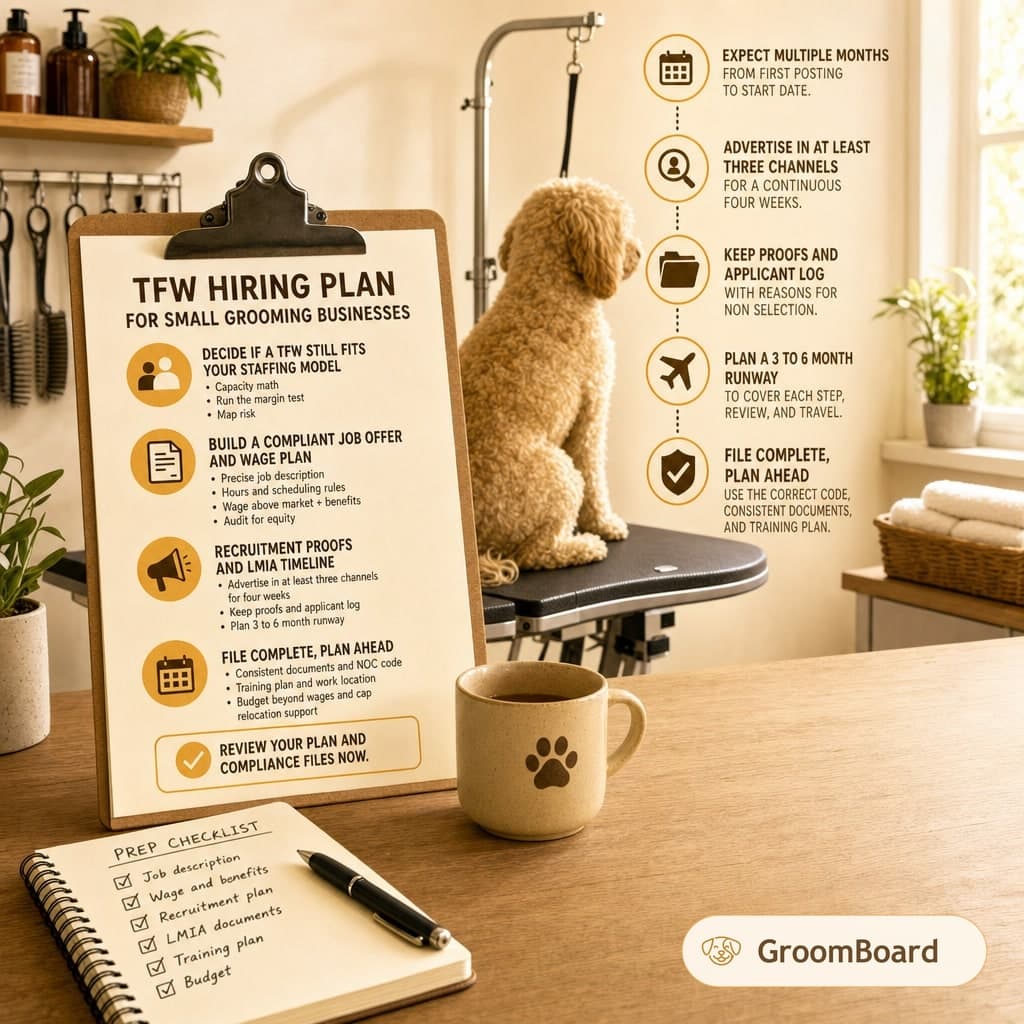
What to do about it
- Treat the revision as a trigger to recheck eligibility, wage offers, and headcount at each location.
- If a per site cap applies, plan headcount, shifts, and revenue targets around one sponsored low-wage role per site.
- Run documented local recruitment for at least four continuous weeks and keep full records, invoices, and screenshots.
- Budget several months from job posting to a TFW’s first shift, and protect revenue with deposits and schedule rules in the meantime.
- Write a detailed job description with duties, tools, and productivity targets so training and compliance are clear.
What changed and who it affects
According to a report from The Economic Times, Canada revised rules for small employers hiring low-wage Temporary Foreign Workers. For grooming salons that rely on entry level bathers or assistants, the change could affect how many roles you can sponsor and the conditions attached. The headline signals a review of your hiring plan and compliance files is due now.
Decide if a TFW still fits your staffing model
Start with capacity math. If an assistant trims 10 to 15 minutes from each full groom through prep, drying, and cleanup, eight full grooms free 80 to 120 minutes. That supports one or two extra bath and tidy slots daily, or lets you finish on time without overtime. If the position will not reliably add one to two billable slots a day, the administrative weight may outweigh the gain in a small shop.
Run the margin test. Price the role at a realistic wage for your city, then add statutory costs, training time, and a cushion for slower output in the first 60 to 90 days. Stack this against what you can book with the added capacity. If the position cannot carry two small dog bath packages or one full groom per day after month three, revisit the plan.
Map risk. If the revision creates a hard limit per location, treat the sponsored role as critical infrastructure. Cross train your senior bather on front desk and laundry, document prep workflows, and keep a bench of casual locals who can step in if travel or permit timing slips.
Build a compliant job offer and wage plan
Write a precise job description. List core duties such as bathing, high velocity drying, nail care, de shedding, prep, sanitation, laundry, and customer handoff support. State equipment used, for example HV dryer, clipper with #10 and longer blades, various slickers and rakes, and PPE such as hearing protection. Give expected pace in plain terms, such as assisting eight dogs a day across mixed sizes after ramp up.
Set hours and scheduling rules in writing. Specify full time weekly hours, break structure, weekend or evening rotation, overtime handling, and any on call expectations during peak weeks.
Post a wage that clears local market noise. Our guidance is to offer at least one to three dollars above your area’s common bather rate if you can. If you use a pay band, publish the band and the criteria for moving up, for example output, rework rate, safety, and client satisfaction. Add a modest benefits line item that survives a compliance check, such as paid sick days or a uniform allowance.
Audit for equity with current staff. Document why the posted wage aligns with your internal scale to avoid compression issues and morale hits.
Recruitment proofs and LMIA timeline
Treat recruitment as a project with artifacts. Our operating guidance is to advertise in at least three channels for a continuous four weeks, for example a national job board, a provincial job board, and a targeted industry group. Keep PDFs of postings, screenshots with visible dates, invoice receipts, and a log of each applicant with reasons for non selection tied to the job requirements.
Expect multiple months from first posting to a start date. Build a 3 to 6 month runway into your calendar. That span needs to cover advertising, interviews, application preparation, review, and travel logistics. If you have a known peak season, back time from that week and set internal deadlines for each step.
File completeness prevents do overs. Use the correct occupation code, mirror the job duties in every document, and keep titles consistent. Describe the work location precisely, including each site if you operate more than one. Prepare a training plan that shows how you will onboard the worker to your tools, safety practices, and humane handling standards.
Budget beyond wages. Plan for government fees, paid advertising, credential verification, and initial gear. If you offer relocation support, cap it and tie disbursement to successful milestones such as 30 and 90 days on the job.
Planning for possible per site limits
If the revision includes a per site cap for low wage roles, for example one sponsored position per location, plan your headcount and schedule around that ceiling. Decide which site needs the role most, based on booked revenue per table and backlog. Move senior staff to the highest yield site during peak weeks and balance the schedule at other locations with regular clients only.
Make that single role count. Assign the TFW to the prep lane that unlocks the most groomer time, usually bathing and drying for large double coats and Doodles booked with your fastest finisher. Set clear daily targets and a coaching cadence with written feedback.
Structure shifts to minimize overtime. A split opening shift that handles intake, prep for the first wave, and cleanup can be more productive than a straight mid shift. Track real output weekly and adjust the appointment mix quickly if targets are missed.
If hiring slips, protect capacity and revenue
Until staffing lands, tighten your book. Prioritize six to eight week regulars over first time or severely matted dogs. Use frequency pricing or a refit fee to keep work inside realistic time blocks. Set a non refundable deposit of 25 to 50 percent for new clients and for any slot over two hours. Publish a clear no show and late cancellation policy and apply it evenly.
Right size appointment lengths. As a baseline, a small dog full groom usually needs 90 minutes to 2 hours, and large double coats need 2.5 to 3.5 hours with proper drying. Book fewer mixed size stacks per table if you are short a bather.
Automate reminders and confirmations. SMS reminders reduce no shows and last minute reshuffles when you are operating at the edge. Tools like GroomBoard can handle online booking, deposits through Stripe, and text reminders without adding front desk labor.
Develop a local pipeline in parallel. Offer paid trials to grooming school grads, cross train a trusted dog daycare worker who wants steadier hours, or run a weekend assistant program with clear safety training. Even one dependable Saturday bather stabilizes your week.