
How to Fire a Grooming Client (Without a Scene or a Bad Review)
Most grooming clients are lovely. A few cost you more than they pay, in missed slots, unpaid bills, bites, tears in the back room, or a Sunday night spent answering texts. Knowing how to fire a grooming client, calmly and on the record, is a basic business skill, the same as pricing or booking. This guide covers when it is the right call, a simple scorecard for deciding, the order to do things in, copyable scripts for each common reason, and how to protect yourself afterwards.
If you are still at the stage of managing a hard client rather than ending things, start with our guide to handling difficult grooming clients, which covers late drop offs, hagglers and scope creep. This page picks up where that one ends.
When It Is Right to Fire a Grooming Client
The reasons that hold up are about conduct, safety, money and reliability. They are things the client does, not who the client is.
- Repeat no shows and late cancellations. One emergency is life. Three empty slots in a year after a written warning is a pattern. Our grooming no show policy guide covers the fee and prepayment steps that come before firing.
- Abuse of you or your staff. Shouting, threats, insults, slurs or unwanted personal comments. This one needs no warning and no scorecard. Your team watches how you handle it.
- A dog that cannot be groomed safely in your setting. Some dogs need medication from their vet, or a veterinary clinic that grooms under sedation, to be groomed without someone getting hurt. Our guide to grooming aggressive dogs safely covers muzzles, handling and when to stop. If you have stopped twice, the honest answer is a referral.
- Chronic matting refusals. The coat arrives pelted every visit, the owner refuses a shave down or a shorter schedule, and then blames you for the clipper irritation. That is a welfare problem as well as a service problem.
- Nonpayment. Bounced payments, unpaid balances, or a card dispute filed after a groom the client collected happily.
- Boundary pushing. After hours demands, refusing to follow your policies after being told them in writing, dishonesty about bite history, or turning every visit into a negotiation.
When It Is Not the Right Call
Firing should be rare. Before you do it, rule these out.
- One bad day. A client who snapped at you once, the week their old dog was diagnosed with something serious, deserves a second chance and maybe a kind word.
- A fair complaint. If the groom really was uneven or the dog came home with a nick, fix it and keep the client. Our difficult clients guide has the script.
- A problem you never put in writing. If your no show or matting policy only lives in your head, the client did not break it. Write it, share it, and give them a chance to follow it.
- A dog that is improving. A nervous puppy who is a little better every visit is a client you are building, not one you are losing.
A Simple Scorecard for Deciding
Gut feeling is unreliable when you are tired and annoyed. Score the last 12 months on six factors, 0 to 2 points each.
How to read it: 0 to 3 points, keep them and maybe adjust the booking. 4 to 6 points, send a written warning with clear conditions, such as a deposit, prepayment or the last slot of the day. 7 or more points, or a 2 on safety or treatment of staff on its own, it is time to part ways.
The math: what one hard client really pays you
This worked example uses assumed numbers. Swap in your own.
- ASSUMED: your usual groom is $80 and takes 1.5 hours, so it earns $53.33 an hour ($80 divided by 1.5).
- ASSUMED: the hard client books every 6 weeks, so about 8 bookings a year. Two are no shows with no fee collected, and the six visits that happen each take 2 hours of your time once you count the late drop off, the extra handling and the argument at pickup.
Revenue: 6 visits at $80 is $480. Time: 6 visits at 2 hours is 12 hours, plus 2 empty slots at 1.5 hours is 3 hours, so 15 hours in total. Effective rate: $480 divided by 15 hours is $32 an hour, about 40% below your usual rate.
Those same 15 hours given to typical clients would earn about $800 (15 times $53.33), so this client costs you roughly $320 a year in lost income. Even if you collect a 50% no show fee both times, that adds $80 and lifts the rate to about $37 an hour, still well short. The gap only turns into income if you can fill the time, which is why this matters most when your book is full or you have a waitlist. Our no show cost calculator runs the missed slot part of this with your own numbers.
How to Fire a Grooming Client, Step by Step
1. Document first
Before you send a word, write down the facts with dates: missed visits, unpaid amounts, what was said and by whom, photos of matting at intake, any bite or injury. Save the texts and emails. Notes like "3/14 no show, no message; 5/02 left 25 minutes late, shouted at Jess at the desk" are what protect you if the client disputes a charge, complains to someone or writes a review. Keep the notes factual, never insulting. Assume the client could one day read them.
2. Check your own policies and what the client signed
Read your cancellation, no show, matting and behavior policies as they are actually written, not as you remember them. Then confirm the client agreed to them, on an intake form, a waiver, or a checkbox when booking. If they did, your message can point to terms they accepted. If they did not, do not charge a fee they never agreed to; just end the relationship cleanly and fix your forms for everyone else. Our grooming cancellation policy template and the free grooming waiver generator cover the wording.
3. Settle the money before you write
Decide in advance so you only have to say it once:
- Future appointments: cancel them all, and say so in the message.
- Deposits for those appointments: refund them. You are the one cancelling.
- Prepaid packages or credit: refund the unused balance.
- Fees already earned under a policy they agreed to, such as a no show fee: you can still collect these, but decide whether it is worth the fight. Sometimes waiving a final $40 buys a quiet exit.
- Open balances: send one final, itemized invoice.
4. Choose the channel
Timing matters too. Send it on a quiet day, not in the middle of a heated pickup. If the dog is in your care, finish the groom, hand the dog back calmly, and send the message later.
5. Send it, then stop
One message. Thank them, say you cannot continue, give one neutral reason, explain any refund, and wish them well. Then cancel future appointments, stop them booking online, and put a note in their file so nobody on your team rebooks them by accident.
What to Say: Scripts for Each Reason
Copy, adjust the details, and keep them short. Every script follows the same shape: thanks, decision, brief reason, practical next step.
Repeat no shows
Hi [name], thank you for bringing [pet] to us. After the missed appointments on [dates], we are not able to keep booking [pet] going forward. We have cancelled the appointment on [date] and refunded your [$X] deposit, which should reach your card within a few business days. We wish you both well.
Abuse of staff
Hi [name], after what happened at pickup on [date], we will not be booking further appointments with you. We have cancelled your appointment on [date] and refunded the [$X] deposit. Please do not come to the salon. We wish [pet] the best.
Do not apologize for protecting your team, and do not debate what was said. If you have been threatened, keep the messages and consider contacting the police; that is not a customer service issue.
A dog that cannot be groomed safely
Hi [name], thank you for trusting us with [pet]. We have stopped [his/her] last two grooms because [he/she] was too stressed to continue safely, and we do not think our salon is the right setting for [him/her]. Please talk to your vet about it. Some veterinary clinics groom under sedation with medical staff monitoring, and [clinic name, if you know one] may be able to help. We are happy to send our notes on what worked and what did not.
This is the one case where a little more explanation helps, because the owner needs to know the dog needs a different setting, not a different groomer. Sedated grooming is a veterinary procedure; this explainer from one veterinary hospital describes how one is done. Groomers should never sedate a dog themselves.
Chronic matting refusals
Hi [name], [pet]'s coat has come in matted for the last [number] visits, and the only safe way to groom a coat like that is a short shave down, which you have not wanted. We are not able to keep grooming [pet] on the current plan, so we will not be booking further appointments. A groomer who does more frequent visits may be a better fit. We wish you both the best.
For the conversations that come before this point, see our guide to matting prevention and client education.
Nonpayment
Hi [name], we still have an open balance of [$X] from [date], itemized below. Please settle it by [date] using [payment link or method]. Going forward we will not be booking further appointments. Thank you for understanding.
Boundary pushing, or simply not a good fit
Hi [name], thank you for choosing us for [pet]. We have realized we are not the best fit for what you are looking for, so we will not be booking further appointments. Your appointment on [date] is cancelled and your deposit has been refunded. We hope you find a groomer who suits you both.
Handling the Response
Most people go quiet. Some reply. Answer once, at most, and never escalate.
- "Why?" "As mentioned, after [the missed visits / what happened on date], we are not able to continue. We wish you well." Do not list every incident.
- "I am sorry, can we try again?" You may say yes, but only on written terms: "We can book one more time with prepayment at booking. If an appointment is missed, we will not rebook." Then stick to it.
- Anger or threats: do not reply to insults. Save everything. If there is a threat of harm, that is for the police, not your inbox.
- A card dispute: respond through your payment processor with the signed policy, the booking record and your notes. This is where the documentation from step 1 pays for itself.
Protecting Yourself
Refuse for conduct and safety, never for who someone is
A grooming business can turn down clients for what they do, such as missing appointments, not paying, abusing staff, or bringing a dog that cannot be handled safely. It cannot turn people away because of a protected characteristic. Federal law bars discrimination by places of public accommodation on the basis of race, color, religion or national origin (Title II of the Civil Rights Act), and the Americans with Disabilities Act applies to almost all types of businesses that serve the public. Many states go further. California's Unruh Act, for example, covers all business establishments of every kind and protects characteristics such as disability, sexual orientation, primary language and immigration status. This is a general overview, not legal advice. Check your own state and city civil rights office, or ask a lawyer, if you are unsure.
Two habits keep you safely on the right side: apply your policies the same way to every client, and make sure your records show the conduct that led to the decision.
Keep records, and keep them boring
Store the incident notes, the final message, the refund confirmation and any reply in the client file. Write the way you would want a stranger to read it: dates, facts, what you did. If a bite was involved, record it the way your grooming insurance provider expects, in case a claim follows.
Responding to a revenge review
A fired client sometimes heads straight for Google. A calm public reply works better than silence and far better than an argument. Our guide to getting more Google reviews has reply templates, but the short version is:
Thank you for your feedback. We take every concern seriously and have reached out privately. We wish you and [pet] the best.
Never share private details, booking history or the reason you ended things in a public reply. If the review breaks Google's rules, for example it is harassing, profane, or written by someone who never visited, you can report it from your Business Profile. Google says plainly not to report a review just because you disagree with it, so keep flags for real violations.
One thing not to do: add a clause to your forms banning bad reviews or charging a fee for one. Under the Consumer Review Fairness Act, the FTC says businesses cannot use form contracts that restrict honest reviews or penalize reviewers.
Prevention: Policies That Make Firing Rare
The best client to fire is the one you never had to, because your policies did the work first. Four of them carry most of the weight.
- Deposits for new clients and repeat no shows. A deposit filters out people who book casually. See the cancellation policy template for wording.
- A card on file. It makes a no show fee something you can actually collect, rather than an awkward request.
- A matting release. A signed release that explains shave downs and their risks ends the "you ruined my dog" argument before it starts. The waiver generator builds one.
- A written no show policy with a clear second step, such as prepayment after two missed visits, so firing is the third step rather than the first.
Add a behavior and bite history question to your intake form too, and record the answer. A client who hid a bite history has broken trust, and you will have it in writing.
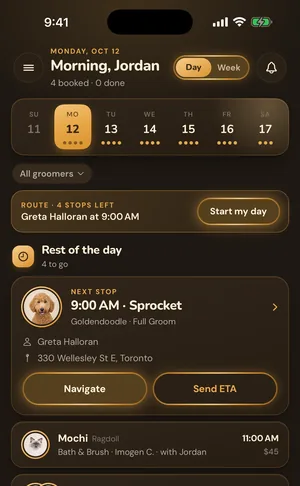
If you run your book in GroomBoard, two things help here. Client notes keep the incident record next to the client and their pets, and the Online booking card on each client's profile lets you stop that one person booking on your booking page while keeping their history and any appointments already on your calendar. They see a message asking them to contact you directly, not a notice that they were blocked.
The Short Version
Fire for conduct, safety, money or repeated policy breaks, and only after one bad day has turned into a pattern. Score it, document it, check what the client agreed to, settle the money, and send one short, neutral message. Refer unsafe dogs to a vet. Reply to a revenge review once, politely, and flag it only if it breaks the rules. Then get your deposit, card on file, matting release and no show policy in place so you rarely need to do it again.