Creating a No Show Policy That Protects Your Time and Income
Why Groomers Need a Written No Show Policy
A no show isn't just an inconvenience, it's a direct hit to your revenue. If you charge $75 per groom and see 8 dogs a day, one no show without a fee costs you roughly $75 in lost income plus the time slot you could have filled. Two no shows a week adds up to $600/month walking out the door. A written, enforced no show policy is the only reliable fix.
The problem most groomers run into isn't writing the policy, it's the awkwardness of enforcing it with a client they've been grooming for three years. This guide covers both: how to build a policy with teeth, and how to hold the line without torching a client relationship.
What a Grooming No Show Policy Should Actually Cover
A lot of policies floating around the internet are vague enough to be useless. "We reserve the right to charge a fee for missed appointments" doesn't protect you when a client pushes back. Your policy needs to define four things clearly:
- Cancellation window: How many hours' or days' notice is required to avoid a fee? Industry standard is 24 to 48 hours.
- No show fee amount: A flat fee (e.g. $25 to $50) or a percentage of the service (e.g. 50% of the groom price). Both work, pick one and stick to it.
- Late cancellation vs. true no show: Some groomers charge a lower fee for a same day cancellation vs. a full no show. Others treat them the same. Either is defensible.
- How the fee is collected: Charged to the card on file, required before rebooking, or invoiced. Vague collection language means the fee never actually gets paid.
You don't need legal language. You need language that leaves no room for "I didn't know."
Sample No Show Policy Language You Can Use Today
Here's a working template. Adjust the numbers to fit your market and clientele:
"We require 24 hours' notice to cancel or reschedule an appointment. Cancellations made with less than 24 hours' notice will be charged 50% of the scheduled service. No shows (appointments missed without any notice) will be charged 100% of the scheduled service. A valid credit card is required to book, and fees will be charged automatically. Clients with two or more no shows may be asked to prepay for future appointments."
That last line about prepayment for repeat offenders is important. It separates the one time emergencies from the serial no shows, and it gives you a graceful off ramp short of firing a client entirely.
Getting Clients to Acknowledge the Policy (So You Can Actually Enforce It)
A policy buried in your website footer is not an acknowledged policy. For enforcement to hold up, and for the conversation to go smoothly, clients need to have actively seen and agreed to it. That means:
- New client intake forms: Your intake form should include a checkbox or signature line confirming they've read the cancellation and no show policy. If you're not collecting this, your dog grooming intake form template needs an update.
- Booking confirmation messages: State the policy briefly in every booking confirmation. Something like: "Reminder: cancellations require 24 hours' notice. Late cancellations and no shows are subject to a fee." It doesn't have to be a wall of text, just enough to establish awareness.
- Card on file at booking: Requiring a card to book is the single most effective deterrent to no shows. Clients who've entered payment info cancel far less often than those who haven't. If you're on a platform that supports card capture, use it.
SMS reminders sent 48 hours and again 24 hours before the appointment also dramatically cut no show rates, not because clients forget, but because the reminder forces the decision. A client who was going to cancel last minute gets the nudge to do it a day earlier instead.
How to Set Your No Show Fee
There's no universal right answer, but here's a practical framework based on what's common across the industry:
If you're in a higher cost of living market, Vancouver, Toronto, NYC, LA, you can hold a firmer line on fees because clients have fewer alternatives and your slots are in genuine demand. In smaller markets where word of mouth is tighter, some groomers start with a warning on the first offense and charge on the second. Either approach works as long as it's written down and applied consistently.
The Conversation When You Have to Enforce It
This is where most groomers fold. A long time client texts an hour before their appointment: "So sorry, something came up, can we reschedule?" You know you should charge the fee. You also know this person has been coming in every six weeks for two years.
Here's the script that keeps the relationship intact while holding the policy:
"Of course, we can reschedule! I'll get [dog's name] booked in next week. Just a heads up, because it's within our 24 hour window, I will need to apply the late cancellation fee of $[X] per our policy. I'll send over a link to rebook. Thanks for reaching out!"
Notice what this does: it acknowledges the reschedule warmly, states the fee matter of factly, and moves forward without making it a confrontation. You're not apologizing for the policy. You're not negotiating. You're just applying it the way you'd apply any other business rule.
If a client pushes back hard on a first offense, you can choose to waive it once as a goodwill gesture, but say so explicitly: "I'll waive it this time, but wanted you to know the policy for future appointments." This documents the grace period and ensures no surprise the second time around.
When to Fire a No Show Client
Some clients will no show repeatedly regardless of fees, especially if they're paying with a stored card and never feel the friction of a real conversation. After two or three incidents, the math often stops working: you're spending more time chasing, charging, and rescheduling than the groom is worth.
Signs it's time to part ways:
- Two or more no shows in a 12 month period with no genuine explanation
- Disputes the fee every time it's charged
- Late to appointments frequently (showing up 20+ minutes late on a tight schedule creates downstream problems all day)
- The dog is difficult, the pay is average, and the reliability is poor
You don't owe an explanation. A simple message works: "We're no longer able to accommodate [dog's name] going forward. We wish you both well." Done. That slot is now available for a reliable client, and finding more of those is covered well in How to Raise Your Grooming Prices Without Losing Clients, which touches on client quality as much as client quantity.
Building the Policy Into Your Day to Day Systems
A policy is only as good as the infrastructure behind it. If you're manually tracking who no showed, manually sending invoices for fees, and relying on memory to flag repeat offenders, the policy will slip. The operational side needs to be nearly automatic.
At minimum, your booking system should handle:
- Card capture at booking
- Automated appointment reminders (SMS at 48 hours and 24 hours)
- Client history so you can see at a glance if someone is a first time or repeat no show
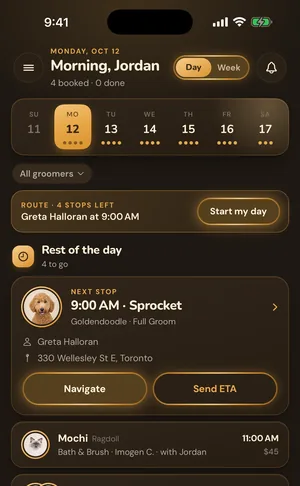
For a deeper look at how software can reduce appointment losses before they happen, our comparison of dog grooming software covers what each platform costs once reminders are included. If you want a lightweight option to get started, GroomBoard's grooming software features include SMS reminders and online payments out of the box, you can start a free trial without entering a credit card.
The Bigger Picture: Fewer No Shows Means a Better Business
Most no shows aren't malicious, they're a combination of forgetfulness, disorganization, and the knowledge that there's no consequence. A written policy, a card on file, and two automated reminders fix roughly 80% of the problem before you ever have to enforce a fee. The remaining 20%, the clients who genuinely don't respect your time, are easier to manage (or remove) once the infrastructure is in place.
Your time has a hard dollar value. Eight appointments a day at an average of $80 means you're generating $640 in daily revenue. Every empty slot is a 12.5% hit to that day. A no show policy isn't a nicety, it's a baseline business protection that every working groomer should have in place.