Dog Grooming Terms Glossary: 45+ Words Every Groomer & Owner Should Know
Grooming has its own vocabulary, and a lot of miscommunication at drop off comes from a client and groomer using the same word to mean different things. This glossary defines 45+ common dog grooming terms in plain English, so whether you're a new groomer learning the lingo or an owner trying to describe what you want, everyone's on the same page.
Services & Haircuts
- Full groom: The complete service, bath, blow dry, brush out, nails, ears, sanitary trim, and a haircut or style.
- Bath & brush (bath & tidy): A bath, dry, and brush out with no haircut, often including nails and ears.
- FFT (face, feet & tail): A tidy up of just the face, feet, and tail between full grooms.
- Puppy cut: One even short to medium length all over. Despite the name, suitable for any age.
- Teddy bear cut: Short, even body with a rounded, fluffy face: the stuffed animal look.
- Kennel cut (summer cut): Clipped short and even everywhere, including the face. Low maintenance.
- Lamb cut: Short body with longer fur left on the legs.
- Lion cut: Body shaved short with the mane, face, and tail tip left full. Common on cats too.
- Sanitary trim: Clipping the hygiene areas around the rear, genitals, and belly to keep them clean.
- Breed standard clip: A traditional cut specific to a breed, such as a Poodle Continental or a Schnauzer skirt.
For a deeper visual breakdown, see our dog grooming styles guide.
Techniques
- Line brushing: Brushing the coat in layers, lifting it and working down to the skin, so no tangles are missed.
- Hand stripping: Plucking dead hair from wire haired breeds at the root to preserve coat texture, instead of clipping.
- Carding: Using a stripping or carding tool to remove loose undercoat and tidy short coats.
- Deshedding: Removing loose undercoat with a dryer and rake to reduce shedding (not the same as shaving).
- Dematting: Removing mats from the coat, brushed out when light, clipped out or shaved when severe. See our dematting guide.
- Scissoring (setting a pattern): Shaping the coat with shears for a finished, even outline.
- Fluff drying: Drying while brushing to straighten and lift the coat for clean scissor work.
- Bathing system / recirculator: Equipment that pushes shampoo deep into the coat for a thorough clean.
Coat Types
- Double coat: A soft insulating undercoat plus a coarse guard coat (e.g. Huskies, Golden Retrievers). Should not be shaved, see why.
- Single coat: One layer of hair that grows continuously (e.g. Poodles, many Doodles).
- Wire (broken) coat: Coarse, harsh coat suited to hand stripping (e.g. terriers, Schnauzers).
- Curly / wool coat: Dense curls that mat easily and need frequent brushing.
- Guard hairs: The longer, coarser outer hairs that repel water and protect the skin.
- Undercoat: The soft, dense layer beneath the guard coat that insulates and is where mats begin.
- Blowing coat: Heavy seasonal shedding when a double coated dog sheds its undercoat in tufts.
- Pelting / pelted: Matting so severe the coat forms a solid mat against the skin, usually requiring a shave down.
Tools & Equipment
- Slicker brush: A flat brush with fine wire bristles for removing tangles and loose hair.
- Greyhound comb: A metal comb used to check the coat is brushed all the way to the skin.
- Undercoat rake: A tool that pulls loose undercoat from double coated breeds.
- Clipper & blade: The cutting tool; blade numbers set the length (higher number = shorter cut).
- Guard comb (snap on): An attachment that extends a blade's length for longer cuts.
- HV dryer (high velocity dryer): A powerful dryer that blasts water and loose undercoat out of the coat.
- Stripping knife: A serrated tool used in hand stripping wire coats.
- Dremel / nail grinder: A rotary tool that files nails smooth instead of clipping them.
- Happy hoodie: A stretchy band that covers a dog's ears to reduce dryer noise and stress.
Health, Safety & Business Terms
- Quick: The blood vessel inside a nail; cutting it ("quicking") causes bleeding and pain.
- Anal glands (sacs): Scent glands near the anus that occasionally need external expression. See our guide.
- Clipper burn: Skin irritation from a hot blade or shaving too close.
- Brush burn: Skin abrasion from overbrushing, often during aggressive dematting.
- Matting release: A waiver clause acknowledging the risks of dematting or a shave down. Build one with our waiver generator.
- Sanitary / hygiene area: The areas around the rear and genitals kept trimmed for cleanliness.
- Express (glands): To gently release fluid from the anal glands.
- Force drying: Using an HV dryer's airflow to dry and straighten the coat.
- Table / loop: The grooming table and the restraint loop that keeps a dog steady and safe.
- Add on (upsell): Extra services like teeth brushing or deshedding. See our add on revenue calculator.
- Rebook: Scheduling the next appointment before the client leaves, key to preventing matting and no shows.
Speak the Same Language as Your Clients
Most pickup time disappointment comes from a vocabulary gap. When you and the client agree on exactly what "short," "puppy cut," or "tidy" means before you start, ideally confirmed with a blade length or a photo, you deliver the right result every time. For more on running smooth consultations, see our styles guide and our guide to handling difficult clients.
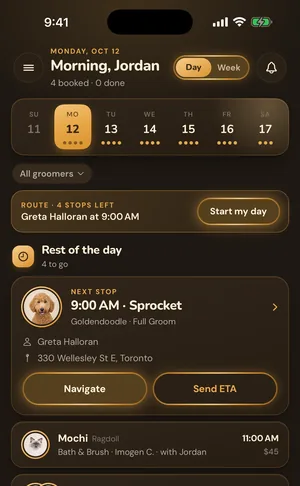
GroomBoard lets you save each pet's preferred style, blade lengths, and notes so the whole team speaks the same language every visit. Start your free 7 day trial →