
How to Become a Dog Groomer: The Three Real Paths, What They Cost, and Your First Year
If you want to know how to become a dog groomer, the honest answer is that there is no single route and no state exam at the end of it. People get in through three doors: a grooming school, a paid program at a salon or a national chain that starts you as a bather, or an online course backed by real practice. This guide compares those three paths using the programs' own published hours, prices and pay, then walks through your first year, the physical side of the job, licensing, what you will earn early on, and how groomers get from a first paycheck to their own book of clients.
Where a number comes from a school or employer, we link the page we read it on in October 2026. Programs change their prices and structures, so check the linked page before you sign anything.
The Three Paths Into Dog Grooming, Compared
The Bureau of Labor Statistics describes it plainly: "Pet groomers often learn their trade under the guidance of an experienced groomer," and they "can also attend grooming schools." Here is what each route looks like in practice.
How to choose between them
- Pick school if you want structured instruction from day one, can cover tuition, and learn best with a teacher beside you. Ask each school for its total hours, how many dogs a student grooms, and its placement rate. The Academy of Pet Careers, for example, publishes an 85 percent job placement rate for 2025.
- Pick a chain academy if you need income now. It is the most predictable way to be paid from the first week while following a published training plan. The tradeoff is pace and production goals. Before you accept, ask whether there is a training agreement that asks you to stay a set time or repay costs if you leave. Neither chain's career page mentions one, so get the answer in writing either way. Our corporate to independent groomer guide covers the move many groomers make afterwards.
- Pick an independent salon apprenticeship if you can find a busy shop with a groomer who wants to teach. Quality depends entirely on that person. Our dog grooming apprenticeship guide covers how to find one and the red flags that mean it is free labor, not training.
- Pick an online course if you cannot leave your job or live far from a school, and you have reliable access to dogs. Treat the externship as essential, not optional, because practice volume is what the online format cannot supply.
Worked example: what each path really costs you
Tuition is only half of it. The other half is the paycheck you give up, or keep, while you learn. Every figure marked ASSUMED below is our placeholder for a reader starting from a $15 an hour job; swap in your own numbers.
The formula is simple: net cost = tuition + (weeks in training × hours a week × the wage you would otherwise earn) minus anything you are paid while training. School is the most expensive path on paper, and some people still choose it because they want a teacher's full attention instead of learning around a salon's busy day. The point of the math is to choose with your eyes open.
Your First Year, Stage by Stage
Whatever door you use, the work is learned in the same order. Nobody hands a beginner the scissors on day one, and the stages below are why.
Using the chains' own numbers, the first solo groom arrives after roughly 125 baths and 200 supervised grooms at PetSmart, or 100 or more supervised grooms at Petco. Those are useful benchmarks even if you train elsewhere: if you have done far fewer, expect to feel slow.
After that, the rest of the first year is about speed. Speed is what turns skill into income, because most groomers are paid per dog or on commission. Suppose a groom takes you three hours in month four and two hours by month twelve. The result looks the same, but your day now holds more dogs, and that changes what it pays. Track your time per dog from the start so you can see it fall.
Skills and Physical Demands, Honestly
Career guides tend to skip this part. It is the part that decides whether you are still grooming in five years.
The skills that matter
- Handling and safety. Reading body language, restraint that is safe for the dog and for you, and knowing when to stop a groom. Our guide to grooming aggressive dogs safely covers muzzle protocols and when to refuse.
- Coat knowledge. Knowing which coats to clip, which to hand strip, and why double coated breeds should not be shaved down.
- Drying technique. Drying takes a large part of every groom, and careless drying can hurt a dog. Learn dryer safety from your trainer before speed.
- Talking to owners. BLS lists scheduling appointments, selling products and spotting problems that may need a vet among a groomer's duties. Explaining a matted coat to an upset owner is a skill like any other.
What the work does to your body
The BLS work environment summary for animal care workers says "some parts of the job may be physically or emotionally demanding, and workers risk injury when caring for animals." The injury data backs that up. In the 2024 Survey of Occupational Injuries and Illnesses, pet care services (except veterinary), the industry that includes grooming salons along with boarding and training, reported:
That is about two and a half times the private industry rate for total cases. In a grooming room the causes are easy to picture: lifting large dogs onto tables and into tubs, hours on your feet, repetitive wrist and shoulder work with clippers and scissors, wet floors, dryer noise, and bites and scratches. There is also the hair: our article on groomer's lung explains why a mask and good extraction matter. None of this is a reason not to groom. It is a reason to insist on a hydraulic or electric table, a tub ramp, hearing protection and real handling training wherever you learn.
Do You Need a License to Be a Dog Groomer?
No US state licenses individual dog groomers or requires a grooming competency exam. What a few places regulate is the facility: Connecticut requires a Pet Grooming Facility License, Colorado licenses grooming facilities under its Pet Animal Care and Facilities Act, and New York City requires a Small Animal Grooming Establishment permit. If you work for a salon, those are the owner's job. If you work for yourself, BLS notes that many states require self employed animal care and service workers to hold a business license, and you will usually need tax registration and insurance too.
For every state, with primary sources and the licensing bills that have been proposed but not passed, see our dog grooming license requirements by state.
Certification: Optional, and Best Added Later
Certification is a voluntary credential from a private body, not a license. BLS puts it this way: "Although not required, certifications may help workers establish their credentials and enhance their skills." The best known skills credential is the National Certified Master Groomer (NCMG), developed by the National Dog Groomers Association of America (NDGAA) and endorsed by the American Kennel Club. The AKC, International Professional Groomers and Fear Free run their own programs too, from short online safety courses to master level practical exams.
For a beginner, the useful order is safety and pet first aid first, then a skills credential once you groom every day. Our dog grooming certification guide compares every credential side by side, with what each tests, the verified cost and how long it lasts.
What You Will Earn Early On
BLS does not publish a wage for groomers alone. The closest official figure is for animal caretakers, the occupation that includes groomers:
Two caveats. These figures cover kennel and shelter workers as well as groomers, and they exclude the self employed, who BLS says make up 25 percent of animal caretakers. Bathers and new groomers typically start toward the lower end while they learn.
Worked example: commission in your first year
Once you groom on your own, most pay is per dog or commission, so your income is a formula you can run yourself: dogs per day × average groom price × your commission share × days a week × weeks a year. Using ASSUMED inputs of a $70 average groom, 45 percent commission, 5 days a week and 48 working weeks:
- 3 dogs a day (an early pace): 3 × $70 × 0.45 = $94.50 a day, or $22,680 a year.
- 4 dogs a day: $126 a day, or $30,240 a year.
- 6 dogs a day: $189 a day, or $45,360 a year.
Tips and any hourly base come on top. Same price, same split, and doubling your pace doubles your pay, which is why speed is the real goal of year one. Run your own numbers in the commission calculator, and see our dog groomer salary guide for pay by setting and region.
The Path From Groomer to Owner
Many groomers eventually want their own book of clients. BLS counts a quarter of animal caretakers as self employed, and grooming is one of the few trades in this field you can run from a single room or a van. The usual sequence looks like this:
- Employee, on hourly or commission pay. You build speed and a following without carrying rent or marketing.
- Booth rent or a suite. You pay the salon a fixed fee and keep what you charge. Whether that beats commission depends on your volume; our booth rent vs commission guide shows the break even math.
- Your own business: a home studio, a mobile van or a storefront salon. Start with our guide to starting a dog grooming business, put the numbers on paper with the dog grooming business plan template. The same guide covers home studios and mobile vans.
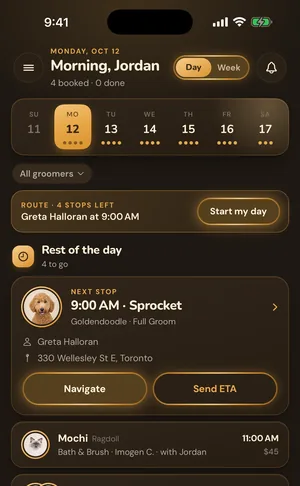
When your first private clients arrive, keep their records from day one: coat notes, the blade you used, the dog that hates its feet touched. If you want that in one place, GroomBoard's Starter plan is $9 a month for one groomer with a simple paper book style view, client and pet records, an online booking page and text reminders, and Solo at $19 a month adds more texts.
A Quick Checklist Before You Start
- Spend a day watching in a working salon, so you have seen a full day of baths, dryers and difficult dogs before you pay for anything.
- Price all three paths with the net cost formula above, using real quotes from schools and real pay rates from local job posts.
- Ask every school or employer how many dogs you will groom before you are signed off, and whether any training agreement is attached.
- Plan for your body: a table that lifts, a mask, hearing protection and handling training.
- Track your minutes per dog from the first week. That number is your raise.
Ready for the business side when it comes? Start a free 7 day trial of GroomBoard, no credit card required.