
Dog Grooming Business Plan: Free Template With Worked Numbers (2026)
A dog grooming business plan is a short document that answers one question: will enough dogs, at the prices you charge, cover your costs and pay you? Everything in it, from the services list to the marketing section, exists to make that answer believable. This guide gives you a section by section template with wording you can copy and fill in, then works the numbers for three common models side by side, so you can see what break even actually looks like before you spend.
If you are still deciding whether to start at all, or need the startup steps (training, registering, equipment, first clients), our guide to starting a dog grooming business covers that, including a one page lean plan. This page is about the full plan document and the math inside it.
Do You Need a Full Plan or a One Page Plan?
The U.S. Small Business Administration describes two formats in its guide to writing a business plan. A lean startup plan "can take as little as one hour to make" and is "typically only one page." A traditional plan goes into detail in each section, "can be dozens of pages long," and is the one "lenders and investors commonly request."
Our rule of thumb:
- Paying cash for a home setup? A one page plan plus the break even math below is enough.
- Financing a van, signing a lease or borrowing anything? Write the traditional plan. A lender will ask for it, and the work of writing it is what catches the mistakes.
A grooming plan does not need to be dozens of pages. Eight to twelve pages with honest numbers beats forty pages of filler every time.
The Dog Grooming Business Plan Template, Section by Section
Each section below has a short note on what it is for, then wording you can copy. Replace everything in [brackets]. The order follows the SBA's traditional structure, adapted for grooming.
1. Executive summary
One page, written last, read first. A lender decides from this page whether to read the rest, so it needs the business, the market, the money and the repayment in plain numbers.
[Business name] is a [home based salon / mobile grooming service / storefront salon] serving [town or area] within a [number] mile radius. We offer full grooms, bath and tidy packages and add on services for dogs [and cats], by appointment. The owner, [name], has [number] years of professional grooming experience and [certification, if any].
We are requesting [$ amount] to cover [van purchase / buildout / equipment / working capital]. We break even at [number] dogs per month and project [number] dogs per month by month twelve, producing [$ amount] in year one owner earnings before tax. The loan will be repaid from operating cash flow over [number] years.
2. Services and pricing
This is the section most plans rush and the one your numbers depend on most. Every price needs a time estimate beside it, because time is the thing you are actually selling. Use our grooming pricing calculator to set prices from your costs rather than copying the shop down the road.
Core services: Full groom, small dog [$ price, minutes]. Full groom, medium dog [$ price, minutes]. Full groom, large dog [$ price, minutes]. Bath and tidy [$ price, minutes]. Puppy introduction [$ price, minutes].
Add ons: [nail grinding, teeth brushing, deshedding treatment, dematting by time] at [$ price each].
Policies: [deposit amount] to book a new client, [number] hours notice to cancel, [late fee or no show fee].
Expected average ticket including add ons: [$ amount].
3. Market and competition
Keep this local. National industry figures show the market exists, but a lender cares whether your town has room for you. For context, the American Pet Products Association reports that 95 million U.S. households own a pet, and puts annual U.S. spending on "other services," a category that includes grooming along with boarding, insurance, training, sitting and walking, at $14.3 billion, projected to reach $14.9 billion in 2026. Note that the category is broader than grooming, and say so if you quote it.
The local work is more convincing: search maps for groomers in your radius, call a few for prices and how far out they are booked, and write it down.
Service area: [towns or zip codes], roughly [number] miles from [base location].
Target clients: [for example, owners of doodles and other high maintenance coats who rebook every 4 to 6 weeks; seniors who cannot easily transport a large dog; owners of anxious dogs who do poorly in busy salons].
Competitors: [Name 1], [price for a medium full groom], [booking lead time]. [Name 2], [price], [lead time]. [Name 3], [price], [lead time].
Our difference: [one sentence, for example "one dog at a time, no crates, done in two hours"].
If you are still weighing dog grooming business ideas, this is where a niche earns its keep. Cat grooming, large and double coated breeds, senior and special needs dogs, and hand stripping for terriers all narrow your market on paper while making you the obvious choice for the people in it.
4. Operations
This section proves you have thought through an ordinary Tuesday. Location, legal setup, equipment, hours, and how a dog moves through your space or your van.
Location: [address or base]. Zoning: [confirmed with city on date / home occupation permit number].
Legal structure: [sole proprietor / LLC], registered [date]. Licenses and permits: [business license, any state or city grooming facility permit, water disposal permit for mobile].
Insurance: general liability and animal bailee coverage from [carrier], [plus commercial auto for mobile / workers compensation if staffed].
Hours: [days and hours]. Capacity: [number] dogs per day, [number] working days per month.
Equipment: [tub, tables, dryers, clippers and blades, shears, kennels, van systems], [owned / financed].
Scheduling and records: online booking, appointment reminders by text, and a record for every client and pet including vaccination dates, temperament and coat notes.
For the permit side, see dog grooming license requirements by state. For coverage, our grooming business insurance guide explains why general liability alone does not cover a dog in your care. And if you need a full equipment list to price this section, use the grooming salon equipment checklist.
5. Marketing and sales
Name the channels, the budget and the target. Vague plans say "social media." Useful plans say how many new clients per month and where they come from.
Brand: [business name] (if you are still choosing, try the grooming business name generator, then check your state registry and domain availability).
Channels: Google Business Profile with photos and service list; [neighborhood groups]; referral cards with [local vets, daycares, trainers]; an online booking link on every profile.
Budget: [$ amount] per month. Target: [number] new clients per month for the first six months, then [number].
Retention: book the next appointment before the dog goes home; target [percent] of clients on a regular 4 to 8 week cycle.
Retention deserves a line of its own. A regular client on a six week cycle comes back about eight or nine times a year, so each one you keep is worth many times a single new booking.
6. Team
For a solo groomer this is a short paragraph about you. For a salon, list each role, how it is paid and when you plan to hire it.
Owner and lead groomer: [name], [experience, training, certifications].
Planned hires: [bather or assistant, hours per week, hourly rate, start month]. [Second groomer, commission or hourly, start month].
Outside help: [bookkeeper or accountant], [insurance agent], [mechanic for mobile].
For wage benchmarks, the Bureau of Labor Statistics reports a median of $17.08 an hour for animal care and service workers in May 2025, the occupation group that includes groomers. The same source puts the median annual wage for animal caretakers at $35,360, and notes that a quarter of animal caretakers are self employed.
7. Funding request
State the amount, the type of financing, what each dollar buys and how you will repay it. Show your own contribution clearly; lenders want to see you have money in the deal.
Total project cost: [$ amount]. Owner contribution: [$ amount] ([percent]). Requested: [$ amount] as a [microloan / term loan / equipment loan] over [number] years.
Use of funds: [buildout $], [equipment $], [vehicle $], [deposits $], [working capital reserve $].
Repayment: [$ amount] per month, covered by operating cash flow from month [number] at [number] dogs per month.
8. Financial projections
The SBA asks for a five year financial outlook, with the first year broken out in quarterly or even monthly detail. For a grooming business, that means four tables: startup costs, monthly fixed costs, a break even calculation and a twelve month projection. The worked example below shows all four.
Worked Financials: Home Salon vs Mobile Van vs Storefront
Every input in this section is an assumption we chose to make the math visible. Rent, van prices, tickets and volumes vary enormously by market. Where a figure comes from a published source we link it; everything else is a placeholder for your own quotes. Copy the structure, then replace the numbers.
Startup costs (one time)
That last row is the one most plans leave out. A storefront needs almost as much in reserve as it needs in owner cash, because its fixed costs run every month whether the book is full or not. Van prices in particular swing widely between a used self build and a new professional conversion; our mobile grooming startup guide walks through that range.
Monthly fixed costs
Insurance figures come from Insureon's published cost pages for groomers and mobile groomers, which it bases on the median cost of policies for groomers who request quotes through it; your quote will depend on location, limits and claims history. The bather's $17 an hour is rounded from the BLS median above. The loan rates are assumptions; the 11% storefront rate sits inside the 8 to 13% range the SBA gives for microloans.
Per dog numbers and break even
The SBA's break even formula is fixed costs divided by price per unit minus variable cost per unit. In grooming, the unit is one dog. Variable costs are what each dog actually uses: shampoo, blade wear, towels and laundry, and card processing, which we assume at 3% of the ticket. Mobile adds fuel and generator running cost per stop.
Show the math for every number in your own plan. For the home salon: $449 ÷ $66.75 = 6.7, so 7 dogs a month covers the business. Add the owner's pay: ($449 + $2,947) ÷ $66.75 = 50.9, so 51 dogs. Year one: 600 dogs × $75 = $45,000 in revenue, minus $4,950 of variable costs and $5,388 of fixed costs, leaves $34,662.
"Owner earnings" here means cash left for you before income tax. Self employed owners also pay self employment tax of 15.3% for Social Security and Medicare, so set aside part of every month. Loan payments include principal, so the van and storefront columns understate profit in the accounting sense while showing the cash you can actually spend. Our grooming profit margins guide explains how to read the difference.
The twelve month projection
New books do not open full. Our 50% year one figure assumes bookings start near 20% of capacity in month one and climb in a straight line to about 80% by month twelve. For the home salon, that is roughly 20 dogs in month one (about $886 left after costs) and 80 dogs in month twelve (about $4,891). Lay your own projection out as twelve columns, one per month, with these rows: dogs groomed, revenue, variable costs, each fixed cost, loan payment, and cash left. Then add a row for your cash balance, starting with your reserve. If that balance goes negative in any month, the plan needs more reserve, lower costs or a slower launch.
What the comparison tells you
- The home salon wins on risk, not on ceiling. Seven dogs a month covers its costs, which is why starting a dog grooming business from home is the lowest risk path, where zoning allows it. Its limit is capacity: one groomer, one room.
- The van trades a payment for a premium. Fewer dogs a day because of driving, offset by a higher ticket. When the loan is paid off, roughly $9,000 a year of payments falls away.
- The storefront is a year two business. With a bather on payroll and rent due regardless, year one at half capacity barely clears costs. At three quarters capacity it catches the other models, and it is the only one of the three that can add a second groomer without a second van.
- Price moves the result more than any cost. Raise the storefront ticket from $85 to $95 and year one owner earnings rise from about $4,800 to about $15,050, more than cutting the entire marketing and bookkeeping budget would save.
To test your own inputs quickly, run them through the grooming income calculator for a salon or home setup, or the mobile grooming profit calculator for a van.
How Lenders Read a Grooming Business Plan
If you are borrowing, the plan is read by someone whose job is to find out whether you can repay. A few facts worth knowing before you apply:
- Personal credit matters most for a new business. The SBA notes that loan eligibility for a new business "is typically based on its owner's personal credit score." Pull your free reports before you apply.
- The break even analysis is expected. SBA guidance says a break even analysis is "usually a requirement in order to take on investors or debt." Put yours in the financial section, with the math shown.
- SBA microloans fit many grooming startups. Microloans go up to $50,000, average about $13,000, run up to seven years, and generally carry rates between 8 and 13%. They can pay for working capital, supplies, equipment, furniture and fixtures, but not existing debts or real estate. They are made by nonprofit, community based intermediary lenders, which set the terms.
- 7(a) loans cover larger projects. The 7(a) program goes up to $5 million, and its 7(a) Small loans go up to $350,000. SBA does not require collateral on 7(a) Small loans of $50,000 or less; above that, lenders follow their own collateral policies.
- Expect to put your own money in. Under the SBA lending rules that took effect in June 2025, startups borrowing through 7(a) generally need an equity injection of at least 10 percent, according to this law firm summary of SOP 50 10 8. SBA revises these rules periodically, so ask your lender what applies today.
Two things make a grooming plan stronger in a lender's eyes: a working capital reserve, so one slow month does not cause a missed payment, and evidence of demand, such as a waiting list, a following from your current job, or competitor booking lead times you collected yourself.
Keep the Plan Alive After You Open
A plan earns its keep after launch, when you compare it with what actually happened. Once a month, check three numbers against your projection: dogs groomed, average ticket and fixed costs. If dogs are behind, look at marketing and rebooking. If the ticket is behind, look at add ons and pricing. If costs are ahead, find the line that grew.
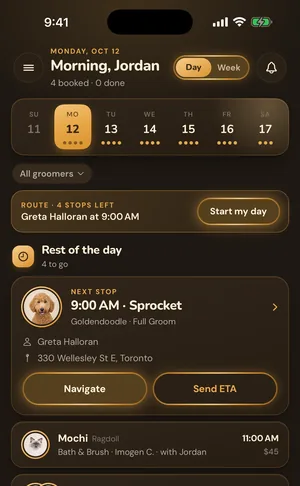
Those numbers are easiest to track when every appointment, price and client lives in one place. GroomBoard keeps client and pet records, online booking and text reminders together, from $9 a month on Starter (one groomer, 100 texts a month) to $39 on Salon (up to five groomers). There is a 7 day free trial with no credit card, so you can set it up before your first client books.
This guide is general information, not financial, tax or legal advice. All worked figures are illustrative assumptions. Get real quotes for rent, vehicles, insurance and financing in your area, and talk to an accountant before you sign a loan.