How to Groom a Yorkshire Terrier: Complete Guide for Professional Groomers
The Yorkshire Terrier is a single coated, nonshedding breed with a fine, silky, human hair like coat that grows continuously. That sounds manageable until you're looking at a 12 week overdue Yorkie with a tangled topknot, a squirmy owner standing six feet away, and a 45 minute slot on your books. Yorkie grooming rewards groomers who understand the coat's unique texture, the breed's temperament patterns, and the handful of standard trims clients actually ask for. This guide covers all of it, coat prep, tool selection, the most common cuts, and how to handle the problems that reliably show up on the table.
Understanding the Yorkie Coat
Yorkshire Terrier coat is unlike most other breeds you'll work on. It has no undercoat, lies flat and straight when healthy, and has a texture closer to human hair than dog fur. This creates two distinct grooming realities:
- The coat tangles, not mats, until it does mat. Neglected Yorkie coat goes from tangled to matted surprisingly fast, especially behind the ears, in the armpits, and around the collar line. Because the coat is fine, mats tighten more aggressively than a Doodle's and are harder to work through without damage.
- Clipper work requires sharp blades and the right speed. Fine, silky coat grabs at dull blades and can fold into the cutting edge. A fresh #10 or #15 for the body, a #30 for sanitary areas, and well maintained snap on combs for longer lengths are nonnegotiable on a Yorkie.
- Coat quality varies significantly between dogs. Yorkies with cottony or wavy coat (a genetic variation) don't lie as flat, tangle more easily, and require more frequent brushing intervals. Flag this on the client card the first time you see it, it affects your pricing and your maintenance recommendations.
Healthy Yorkie coat in full length is glossy, parts cleanly down the center of the back, and flows evenly. If you're seeing dullness, breakage, or a dry brittle texture, ask about diet and any recent medications. It's not uncommon and worth noting in your client records so you're not chasing a problem that has nothing to do with your technique.
Tools You'll Actually Use
You don't need a dedicated Yorkie toolkit, but a few specifics matter:
- Blades: #10 or #15 for body work depending on how short the client wants it. #7F if they want a slightly longer finish on the body. #30 or #40 for pads and sanitary areas. #10 reverse on the face to get clean lines without going too short.
- Snap on combs: A 1/2" to 3/4" comb over a #30 blade is the workhorse for the puppy cut body length most pet owners want. Get clean lines from your comb work, ragged comb lines on a Yorkie are very visible given the coat's fine texture.
- Scissors: Straight shears (7 to 8") for the body and legs, curved shears for the head shape and rounding the feet, small blunt nose or safety scissors for around the eyes. A pair of thinning shears helps blend any harsh comb or clipper lines.
- Slicker brush and greyhound comb: Essential for thorough pre bath dematting and post bath drying work. A medium coarse greyhound comb is your test, if it doesn't run cleanly through from root to tip, the dog is not ready for the tub.
- Forced air dryer: Yorkies dry beautifully with a high velocity dryer. Stretch the coat while drying to prevent wave or curl from setting in. Cage drying alone leaves the coat with texture that makes your scissor work harder.
Pre Bath Prep and Dematting
Do your detangling work before the bath. Wet coat tightens mats and makes them harder to work through. On a Yorkie, pay particular attention to:
- Behind and under the ears (the #1 mat location on the breed)
- Armpits and groin
- The collar line, if the dog wears a collar, this is always a problem area
- The topknot area if it's been rubber banded
For light tangles, a detangling spray worked through with a slicker and then a comb is sufficient. For tighter mats, use a mat splitter or dematting comb to work through in sections, always holding the base of the mat so you're not pulling the skin. On a fine coated breed like a Yorkie, snapping or breaking the coat is a real risk, slow and methodical wins over aggressive technique.
If the dog is significantly matted, particularly around the ears or neck, have the shave down conversation with the owner before you start. On a Yorkie, matting that's close to the skin in the ear area sometimes means going shorter than the owner expects. It's a conversation worth having at drop off, not at pick up.
Bathing and Drying
Use a moisturizing or silk protein shampoo. Yorkie coat responds well to products designed for fine or silky coat types. Avoid anything too heavy or conditioning forward on the body if you want the coat to lie flat and part cleanly. A light leave in conditioner or finishing spray applied before drying helps with static and adds the characteristic gloss.
Blow dry with a high velocity dryer on low heat, stretching the coat downward as you dry. Work section by section. The goal is a flat, straight coat, any wave or body left in will show in your finished cut. Finish with a slicker and comb to confirm the coat is fully dry at the root before you pick up scissors.
The Puppy Cut: What Most Pet Owners Want
The vast majority of your pet Yorkies are getting some version of a puppy cut: a uniform all over length that keeps the dog comfortable, manageable at home, and on a 6 to 8 week grooming schedule. Here's a reliable sequence:
- Body: Clipper or comb attachment work from neck to tail base, following coat growth direction. Most clients want 1/2" to 3/4" body length. Blend the neck and shoulder transition carefully, this is where choppy lines show up most on Yorkies.
- Legs: Scissor the legs into a cylinder shape. Yorkie legs should look neat and even, not feathered or columnar like a show dog. Round the feet with curved shears, being careful not to remove so much foot coat that the nails become prominent.
- Tail: Scissor to a neat point or rounded finish depending on your client's preference. The tail should complement the body length.
- Head and face: This is where the Yorkie cut is won or lost. Trim the muzzle hair level with or slightly above the nose leather. Round the top of the skull and blend into the neck. Clean the inside corners of the eyes with small blunt scissors, never let coat hang over the eyes. The topknot, if the owner requests one, is a bow or clip above the part line; if they don't, scissors and thinning shears blend the crown smoothly.
- Ears: Trim the top 1/3 of the ear leather with a #10 or #15, following the natural V shape of the ear. Scissors clean up the edges. Pluck or clip ear canal hair as needed.
- Finish: Clean pads with a #30 or #40, sanitary trim, nail clip and file.
The Show or Traditional Yorkie Trim
You won't see this often in a pet salon, but it comes up: usually from an owner who shows dogs or has a strong preference for the breed standard look. The traditional Yorkie show trim means:
- Floor length body coat, parted cleanly down the spine from occiput to tail
- The topknot tied up with a single bow, center parted
- Face fall trimmed level with the corners of the mouth or longer
- Mustache and beard shaped but not dramatically cut
- Leg coat left long and shaped into a smooth, flowing column
- Ears trimmed on the top third and edged neatly
In a pet setting, owners who want "long but neat" usually want a modified version of this, floor length or near floor length coat that's been cleaned up, trimmed for eye clearance, and tidied at the edges. Your scissor work here is mostly about maintaining evenness and a clean part. Charge appropriately: a full length Yorkie takes significantly more time than a puppy cut.
Common Challenges and How to Handle Them
The Wiggly Yorkie
Small terriers on a table are a breed category unto themselves for movement and resistance. Yorkies in particular can be dramatic about feet, ears, and face work. A grooming loop and a well positioned arm are your first tools. For persistent movement during face work, bring the dog to the edge of the table and use your body to stabilize. Reward calm behavior with verbal praise, you're conditioning as much as you're grooming. If a dog is genuinely unmanageable, document it on the client card and have the owner know. Some Yorkies benefit from a muzzle during nail work specifically.
Cottony Coat
Some Yorkies carry a recessive trait that produces a soft, cottony, or wavy coat instead of the standard silky texture. This coat mats faster, doesn't lie flat, and doesn't finish as cleanly. It requires more frequent grooming intervals (every 4 to 6 weeks instead of 6 to 8) and more aggressive dematting at each visit. Clients with cottony coated Yorkies should pay more, both because the groom takes longer and because the maintenance burden is higher.
Tear Staining
Visible on lighter faced Yorkies. Document it at intake so the client isn't surprised and can't attribute it to something you did. A short trim around the inner corners and across the muzzle keeps the wet coat from sitting against the skin and making it worse. Tear stain remover products can help between visits, but the root cause is typically anatomical (shallow tear ducts) or diet related, outside your scope, worth mentioning to the vet.
Topknot Damage
Rubber bands left in too long, bands twisted too tightly, or bands placed too close to the root will break Yorkie topknot hair over time. When you see this, note it. Some owners don't know it's happening. Switch them to proper Yorkie bands (the tiny latex ones, not rubber bands from the office supply store) and show them where to place the band to minimize tension.
Setting Realistic Grooming Intervals
For most pet Yorkies, a 6 to 8 week interval works well at puppy cut length. Longer coat needs 4 to 6 weeks to stay manageable. At consultation, set the expectation clearly: a Yorkie that comes in every 10 to 12 weeks is going to need more dematting time, and that means a longer appointment and a higher price. Build this into your intake conversation so clients understand what drives the cost.
Keeping good notes on each dog, coat condition at arrival, mats found, products used, client requests, saves time at every subsequent appointment and keeps you from repeating conversations. A clean client management system like Pet Grooming Business Software: The Complete Guide to Reducing No Shows, Filling Empty Slots, and Increasing Revenue (2026) can walk you through what to look for in software that fits your workflow, whether you're running a solo book or a multi groomer shop.
Pricing Yorkie Grooms
Yorkies are small dogs, but don't let that anchor you to a "small dog price." The time involved in a well executed Yorkie groom, particularly the scissor work on the head and the coat prep, is often comparable to a medium dog. A reasonable pricing structure for most markets:
Prices vary by region, urban markets skew higher, rural markets lower. These are midrange estimates for a competent professional groomer in a North American market. Adjust for your cost of living, chair time, and the specific dog in front of you. A Yorkie that takes 90 minutes because of mat removal should be charged accordingly, not squeezed into your standard small dog rate.
If you're also curious how other breed grooms compare in terms of timing and technique, the How to Groom a Standard Poodle: Complete Guide for Professional Groomers is worth reading alongside this one: the contrast in coat type and scissor work is instructive.
A Note on Client Communication
Yorkie owners tend to have opinions. Many of them have been looking at photos on Instagram and have a specific vision that may or may not match what's physically possible given their dog's current coat condition. Your job at intake is to align expectations: ask what they want, show them what you're working with, and give them a realistic outcome. A two minute conversation at drop off prevents a difficult pickup. Document what was agreed on, especially for first time clients.
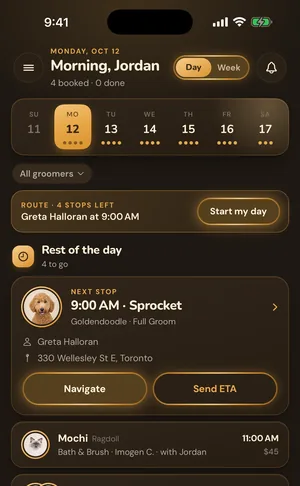
Automating your reminders and keeping clear appointment notes also reduces last minute scrambles. GroomBoard's SMS reminders and client profiles make it easy to flag notes like "cottony coat, charge extra" or "no scissors near ears, dog reactive" before the dog is even on your table. If you want to see how it fits into your workflow, you can start a free trial, no credit card required.