
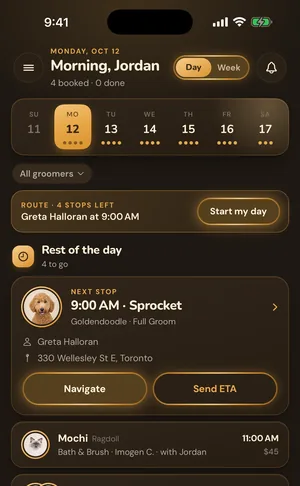
GroomBoard on your phone.
Your day, your route and checkout in your pocket. Sign in with the account you already have.
- iPhoneApp StoreIn review
- AndroidGoogle PlayComing next
GroomBoard on your phone.
Your day, your route and checkout in your pocket. Sign in with the account you already have.
- iPhoneApp StoreIn review
- AndroidGoogle PlayComing next
Hand Stripping
Traditional plucking technique that maintains wire coat texture for terriers and spaniels.
Turn specialty expertise into predictable revenue with GroomBoard's service level durations, variable pricing, and recurring bookings.
Hand stripping is the traditional method for maintaining wire coated breeds, terriers, spaniels, and several working breeds. It is the manual pulling of dead outer coat in the direction of growth, either with a stripping knife or with finger cots. It is the only way to preserve the wire texture that defines these breeds; clipping softens the coat and dulls the color over time. A full strip is a 2 to 4 hour session done every 8 to 12 weeks, with lighter "rolling strips" in between. Hand stripping is a skilled service that few general groomers offer. It commands premium pricing ($100 to $250) because of the time, the technique, and the scarcity of the skill. For breed purists and working breed owners, it is the only acceptable service. GroomBoard's scheduling and per pet SOP documentation support both the long sessions and the rotation between full strip and rolling strip visits.
What working groomers run into
Real challenges with hand stripping
Product and tool costs add up
Specialty work uses premium product and specialized tools. Price accordingly, and track product usage so the margin stays healthy.
Client education is part of the service
Clients need to understand why the price and schedule differ. Save common education snippets and send them in booking confirmations.
Not every groomer can do it
Specialty services require training and experience most general groomers do not have. Position your expertise in confirmations, booking pages, and marketing.
Why groomers run this service on GroomBoard
Built for real world hand stripping workflows
Long session scheduling accommodates 2 to 4 hour hand stripping appointments
Rolling strip vs full strip rotation documented per pet
Premium pricing tier protected by accurate time and skill pricing
Scarcity of the skill attracts clients from a wider radius: a reputation service
Per breed SOP notes ensure every stripper follows the same technique
Step by step
How hand stripping works
Assess the coat stage
Determine whether the coat needs a full strip, a rolling strip, or a light tidy. The coat cycle dictates the approach. Feel the undercoat with fingers.
Strip in the direction of growth
Use a stripping knife as a guide, not a cutter. Roll the dead coat between thumb and knife, pull in a single quick motion. Finger cots work for small areas.
Bathe after the strip
Mild shampoo only, heavy conditioners soften the coat, which is the opposite of what you want. Rinse thoroughly.
Blend with thinning shears
Light thinning work blends stripped areas into clipped only areas (belly, inside legs). Most of the dog should be stripped; shears only for blending.
Schedule the next rotation
Full strip every 8 to 12 weeks, rolling strip every 3 to 4 weeks between. Book both visits before the client leaves.
Recommended tools for hand stripping
The gear that makes hand stripping faster and cleaner, each guide ranks the top professional picks for 2026.
Best Dog Grooming Shears & Scissors (2026)
Straight, curved, blender, chunker: the four shears every working groomer needs, plus how to judge convex edges, steel quality, and ergonomics so your kit lasts years instead of months.
Best Slicker Brushes & Deshedding Tools for Dogs (2026)
The right slicker, rake, or deshedding tool depends entirely on coat type. Here are our top picks for double, curly, silky, and wiry coats, plus how to line brush without causing slicker burn.
Breeds that need hand stripping most
Match the service to the coat. These breed guides go deep on the specific workflow for each.
Airedale Terrier
Every 6 weeks · 4/5 difficulty
Miniature Schnauzer
Every 5 weeks · 3/5 difficulty
Scottish Terrier
Every 6 weeks · 4/5 difficulty
West Highland White Terrier
Every 5 weeks · 3/5 difficulty
Standard Schnauzer
Every 5 weeks · 3/5 difficulty
Hand Stripping across top cities
GroomBoard powers grooming businesses across the country. These city guides break down the local market.
Hand Stripping FAQ
What is hand stripping and why does it matter?
Hand stripping is plucking dead outer coat by hand from wire coated breeds (terriers, most notably). It preserves the wire texture and rich color that define these breeds. Clipping the same coat produces a softer, duller result, fine for a pet, wrong for show quality or breed purist maintenance.
Does hand stripping hurt?
Done correctly, no. The outer coat is already dead and releases easily when pulled in the direction of growth. If the dog seems uncomfortable, the groomer is pulling live coat: the wrong technique. Good strippers work in comfortable positions with breaks.
How often does a terrier need hand stripping?
A full strip every 8 to 12 weeks, with rolling strips every 3 to 4 weeks in between. Show dogs follow a more frequent schedule timed to ring dates. Skipping rolling strips between full strips means the full strip takes longer.
Can I just clip my terrier instead?
You can, but the coat will gradually lose its wire texture and color. After several rounds of clipping, hand stripping no longer produces the original texture: the follicle stops producing the same coat. If you want the breed look preserved, commit to hand stripping from the start.
Do clients expect before and after photos?
Yes, especially for specialty work. A simple before/after upload attached to the appointment record gives clients something to share on social media. It also documents your craft visit over visit.
How much should I charge for a specialty groom?
Calculate time cost first: a 3 hour specialty groom at a $60/hour target rate plus $15 to $30 in premium product is $195 to $210 minimum. Then price for the scarcity of the skill. Few groomers can do what you do, charge accordingly.
Run hand stripping on GroomBoard
The features working groomers use to keep every service priced right, timed right, and rebooked on rhythm.
Service Level Scheduling
Set accurate durations per service so your calendar reflects real time, not guesses.
SMS Reminders
Automatic reminders keep clients on the right cadence for every service.
Online Booking
Clients self book the right service with pricing and add ons visible upfront.
Pet Profiles
Document product choices, temperament, and photos per pet and per service.
Pricing Index · derived from regional and breed multipliers
Hand Stripping typically runs $85 to $350
That range spans the low end of small short coated breeds in dry desert regions through the high end of large double coated breeds in coastal metros. See the full Service × Region and Breed × Service matrices in the Pricing Index.
Ready to price and schedule hand stripping accurately?
7 day free trial. No credit card. Every service configurable in minutes.